

Perhaps England doesn’t produce more eccentrics than any other country. Maybe it’s only that in England eccentricity is cultivated to such a high degree. Adam Smith’s nation of shopkeepers is also the home of the tinkerer, the inventor and the creator. Such as Eric Delaney.
Delaney was the owner of Delaney-Gallay, a subcontractor for the British Ministry of Defense. The firm was a supplier to the aircraft and automotive industries making, among other things, radiators for Ford.
History/driving impressions originally published in AutoWeekMarch 4, 1991; republished by author John Matras.
Delaney was apparently an automotive enthusiast as well, because he had another Englishman, John Griffiths, build him a chassis. Griffiths had been building simple tubular chassis for Ford V-8 specials and Delaney asked for one scaled to a Ford 10 engine, a little 1172 cc E93A four-cylinder.
Delaney took the completed chassis – the parallel main tubes large enough for a Rolls-Royce aircraft engine – to his shop were a custom aluminum body of his own design was crafted.
And what a shape it was.
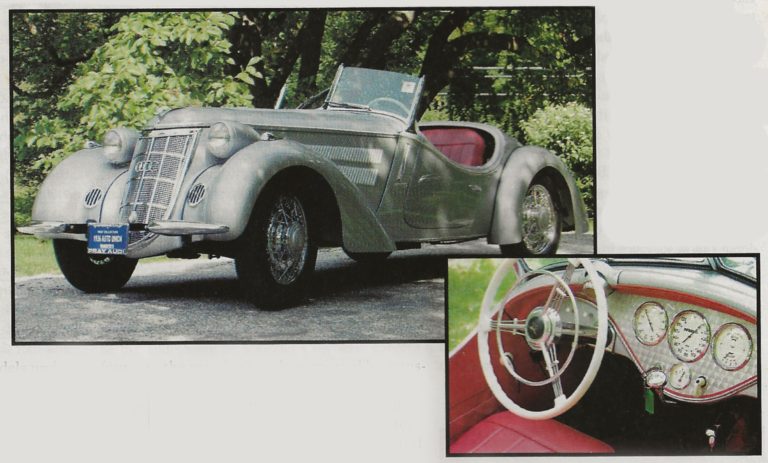
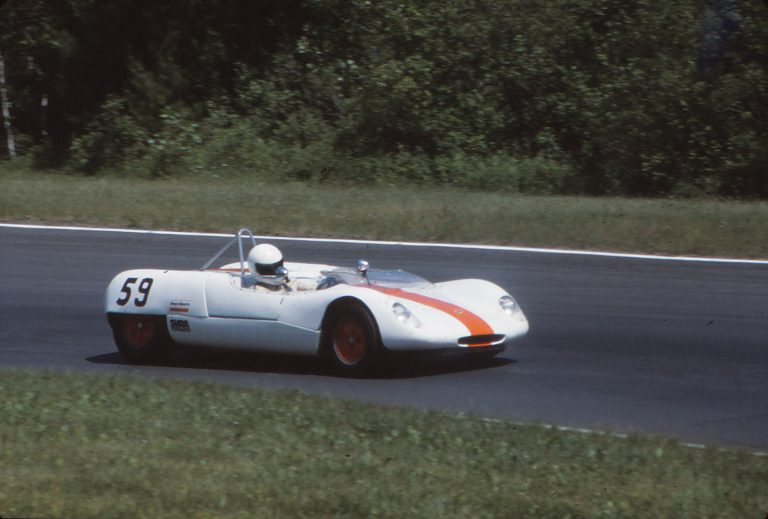
Unlike a contemporary Lotus, Morgan or even MG, Eric Delaney’s sportster was a sophisticated, complex shape. A straight edge won’t follow rounded increased body contours anywhere. The aluminum bracing underneath took hours to cut, shape, weld and finish. Rounded pods envelop the front suspension and instead of simple off-the-shelf stampings, Delaney covered the front wheels with magnificent aeroform spats.
Eric Delaney’s foresight included maintenance. Both front and rear body sections pivot up to expose the mechanical bits beneath, the front even having integral (if heavy looking) props to hold up the hood. The rear bumpers pivot to clear the rear section. The Delaney Delta has doors, but thumb screws hold them closed and is easier to step over than open them. Delaney even made a removable hardtop for his creation, even if it does look rather out of proportion.
But then the body itself is somewhat oddly proportioned. The overall layout is good and the side view attractive. But the car seems to change shape as you walk around it. From one angle it’s almost handsome, but from another it seems comic and bizarre. If nothing else, it shows how difficult automobile design really is.
Under the bodywork, however, lurks the real wonder of the Delaney Delta. Double A-arms of undetermined origin along with coil springs, tube shocks and a custom upright compromise the front suspension. In back there is a torque-tube rear axle with a transverse leaf spring and lever shocks. Brakes are big Ford hydraulic drums. Steering is a very direct Citroen rack-and-pinion, and wheels are Ford Popular type with 5.60×13 Michelins (mud tires at the rear).
There are three interconnected fuel tanks under the Delta’s floor, with independent leads from two of them, each with its own floor-mounted petcock, designed almost as if Delaney was into, say, “custom fuels” for his competition outings.
In addition to a straight pipe for racing, the Delaney Delta has a muffled road exhaust system. Full road equipment, by the way, was furnished: Headlights, parking lights, brake lights, speedometer, windscreen, charging system and an electric cooling fan with blades seemingly big enough only to cool its own motor, much less draw air through the radiator. Oddly there’s no tach, perhaps because you could rev the little flathead ‘til the valves float without hurting anything.
And that engine is perhaps the prize gem in this rolling jewelry. It’s not certain why Eric Delaney chose the 1172 cc Ford, except that it was popular for club racing. But why modify a small unit so extensively when a larger engine would have provided the same performance with less effort? Whatever the reason, the Delta’s tiny four sits amidship in front of the driver.
The standard Ford crankshaft is balanced, the rods polished, the head modified, valve springs competition type and a race cam is installed. There is a Vertex magneto and four-branch tubular headers swept back toward the rear. Twin V-belts drive all the accessories, including a remote side-mounted water pump that supplements the normal thermo-siphoning of the Ford four-banger. The radiator is too low for such “natural” cooling anyway, and a remote header tank sits over the engine. Top it off is a Roots-type Marshall supercharger fed by a 1.25-inch SU carburetor.
It’s also the kick of driving the Delaney Delta. Torque is instantaneous and so abundant that it must be coming from some torque savings & loan somewhere. The Delaney makes withdrawals when the throttle’s pushed.
The Citroen steering is precise and the leverage perfect for quick changes in direction. However, other controls leave something to be desired. The pedals are bottom-hinged, identical in shape and feel, and close together as well. The shifter is vague and recalcitrant until one learns its ways.
Gaps in the floorboards also prove that Delaney, though good, didn’t think of everything. He did, however, fit a Delaney-Galley “number plate” to the firewall!
Eric Delaney raced the car primarily with the London Motor Club in the mid-‘50s. The Delta then sat unused for years before being sold in 1970. It changed hands again in the late ‘80s before it was recently bought and restored (little was needed) by Mark Evans, owner of New England Classics in Stratford, Conn. It made its vintage racing debut at the Hunnewell Hill Climb last May.
Many dream of building their own car. A few try. Fewer still complete the task. Only a handful build their own car as well as Eric Delaney’s highly individual and wonderfully unconventional Delaney Delta. May England always nurture its band of eccentrics. They’re always a joy to us boring, normal folks.
Addendum: Eric Delaney’s Delta was a one-on-a-kind automobile. Helmut Schlosser built the his. Check out the Asardo here. John Kibler built his crazy propeller-pushed Aircar; see it here.