

It started with an Englishman named Wall and would lead to a pair of major league manufacturers, but at the moment it was bounding through the outfield grass of a ballpark in New Kensington, Pa. At the wheel was Jimmy Altman, all of 88 and grinning like a kid as two Briggs & Stratton horsepower pushed us over the freshly clipped turf. This was the 1920 Briggs & Sratton Auto Red Bug, six hardwood slats, two axles, four wheels, a pair of buckets, a steering wheel, and a most improbable and ingenious powertrain.
It’s the soul of simplicity. After all, if pedaling a bicycle were too enervating (Edwardian ladies could take years to recover from an episode of overexertion) and motorcycles too difficult to ride, why, simply put a sideboard motor and wheel on a bicycle. Which is what Mr. Wall did in his Wall Motor Wheel.
History/driving impressions originally published in AutoWeek January 2, 1989; republished by author John Matras.
Enter oneA.O. Smith, a Yank vacationing in England. He decides the Wall Motor Wheel is just what America needs, and promptly obtains manufacturing rights. Returning home to Milwaukee, Smith starts building a motor wheel of his own. Bright red and on the market in October 1914, the Smith Motor Wheel is a hit. The A.O. Smith Co. even opened a new plant just to build it.
The U.S. version was much improved over its predecessor, however, which had a four-to-one reduction chain drive off the exhaust valve camshaft that with two lobes ran at a quarter of crank speed. Smith replaced the spoked wheel with a 20-inch disk connected directly to the camshaft which with four lobes ran at an eighth engine speed. The intake valve was atmospheric, sucked open by the downstroke of the piston and closed by a week spring. “Horns” off either end of the crankcase attached to a pivot and the fender and gas tank.
Jimmy Altman was just a teenager in ‘14 and the Smith Motor Wheel intrigued him. Watching plant workers pop-popping to work aboard their bicycles, he knew he had to have a motor wheel of his own. Working and saving every nickel, he had one – for $45 – by Christmas 1915. With plow handles, runners and traction fashioned from the family dog’s chain, it pulled strings of skaters around the nearby lake all winter. The next summer it was attached to a bike.
A.O. Smith sold thousands of motor wheels between 1914 and 1918 with only minor variations in year-to-year, but in 1916 the Automotive Electric Service Corp. of North Bergen, N.J., attached one to the back of an automotive variant called a buckboard, a cycle-wheeled cart whose suspension consisted only of a thin layer of padding in the seats and the flexing of the wooden slats that formed its frame. Smith liked the idea and the resulting collaboration was the Smith Flyer. Smith provided the motor wheels and the New Jersey firm the rest of the car. For $135 in 1917 one received a pine box containing the former and a crate with the latter. Some assembly required. But then again, it was the least expensive auto ever sold in the US.
S.F. Briggs and H.M. Stratton bought manufacturing rights to the Smith Motor Wheel in 1919, continuing buckboard production as well, though marketing it as the Briggs & Stratton Flyer. The biggest change was an increase in bore that doubled horsepower – to two. Somewhere about 1920 the name was changed to the Auto Red Bug flyer, a takeoff on the trim which you could get in any color as long as it was red.
Briggs & Stratton sold thousands of motor wheels and buckboards. And whatever it was, it wasn’t a toy, although Brigg & Stratton proclaiming such in an ad suggested there was some doubt even then. It was, said Briggs & Stratton, “a sturdy, strongly built and highly efficient two-passenger vehicle combining all the delights of motorsport with the practical convenience of rapid transportation at an insignificant cost.”
Their expected customer was obvious: “Just imagine riding over 80 miles on one gallon of gasoline, at a rate of between four and 25 miles an hour, along some delightful boulevard or over a picturesque country road with a charming young lady for a companion.”
But by 1923, Ford’s Model T was closing in. A roadster would sell new for $260 in 1925 and a used T often sold for a tenth that or less. However, Briggs & Stratton sawed the horns off the motor wheel and attached the engine to a cultivator. And never looked back. Motor wheel production ceased and the buckboards, with electric power, were available only from the North Bergen builder.
Re-enter Jimmy Altman. Over the years he’s retained a fondness for the motor wheel and now has restored more than 30 buckboard’s, winning Antique Automobile Club of America awards, and provided parts and assistance in the revival of others, earning the title “Mr. Red Bug.” The one in which I rode, and drove, he said might be his last.
One starts a Briggs & Stratton Red Bug by first lifting the motor wheel off the ground with the lever between the seats. Then, standing behind the vehicle, grab the knob on the wheel and spin it, pressing the compression release with a finger of the left hand. Before the wheel stops, choke the carb with the same finger, taking care not to get it in the cooling fan inches away. It pops, maybe, and clatters to life.
Scrunch behind the wheel, knees high. Get a push and lower the motor wheel – and with luck it won’t stall. Up to speed – hand throttle on the steering wheel hub – and it feels like it. Steering is one-to-one and chassis flex sincerely wants to dump the driver on right turns. The motor wheel, bouncing over bumps, jolts the lifting lever. Shin guards, anyone? Altman concedes a shortcoming in climbing hills, mainly from a lack of torque. But with the motor wheel weighing 65 pounds and the buckboard only 50, traction is not a problem. Stopping is. Brakes are inside the front of the rear fenders, pushed back against the tires by a rod and foot pedal to slow. And stop. Eventually. Reverse? Dig in a heel and push.
If the Smith Flyer/Briggs & Stratton Auto Red Bug made no great strides in automotive technology, is because none were intended. In a time when motoring was for the wealthy, the humble buckboard let the less well-to-do have a little road fun. And without the little buckboard, who knows where – or if – A.O. Smith and Briggs & Stratton would be today.
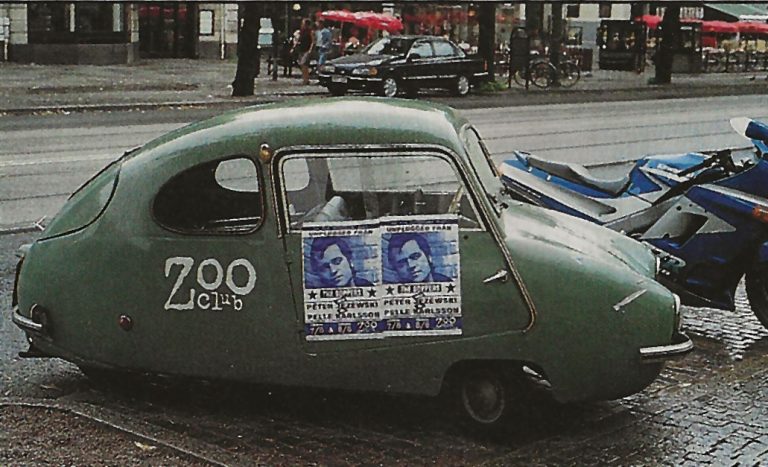
Addendum: If you want to know the cheapest, smallest and lowest powered automobile—and “automobile” rightly should be in caps—I’ve ever driven, this is it. But it brought the inner ten-year old in me. It’s not, however, the only single-cylinder I’ve ever driven. Consider the BMW Isetta, a BMW I highly anticipated getting in.
Jimmy Altman wasn’t just a Briggs & Stratton Auto Red Bug enthusiast. He was also a fixture in speedboat racing, appropriately enough in smaller-engined classes.