

The Panhard story dated back to the dawn of the automobile age, the first Panhard built in 1890. It continued into the brass era and through the Great Depression in France with the upper class and technologically advanced Panhard Dynamic. War shattered the economy of France and to regroup, the country developed an industrial plan that left Panhard out in cold. France had no need of cars that catered to the well-to-do.
Panhard developed a plan of its own, however, a car for the common Frenchman, with two horizontally-opposed cylinders and front drive, small but big enough. That was the Panhard Dyna, or as it would also be called, the Dyna Panhard. I wrote the history of Panhard’s postwar adventures for Automobile Quarterly. For Remember Road, I’ve broken the long story into the beginning of Panhard et Levassor in 1890, through the Panhard Dyna of 1959, that history is available here. For the end of Panhard automobiles, keep reading.
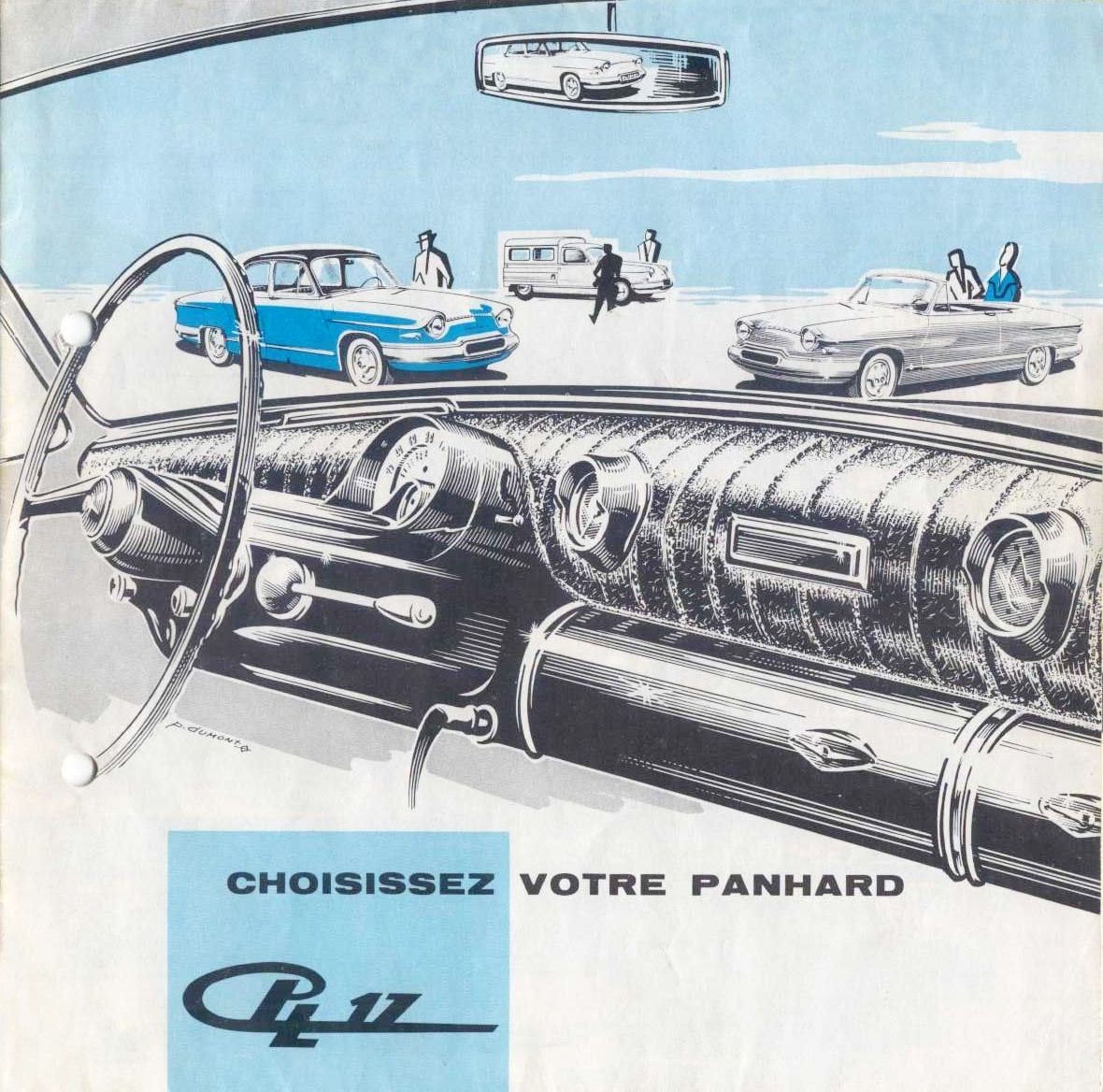
PL 17 – The next generation of the dyna panhard
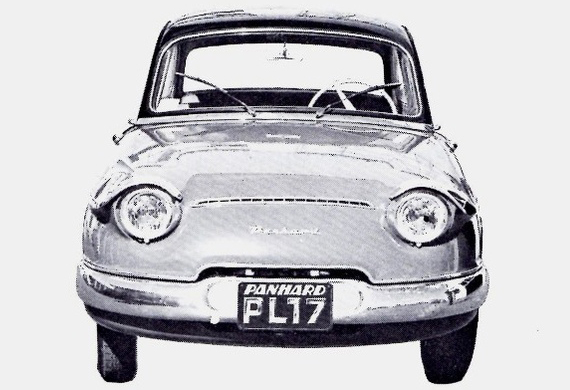
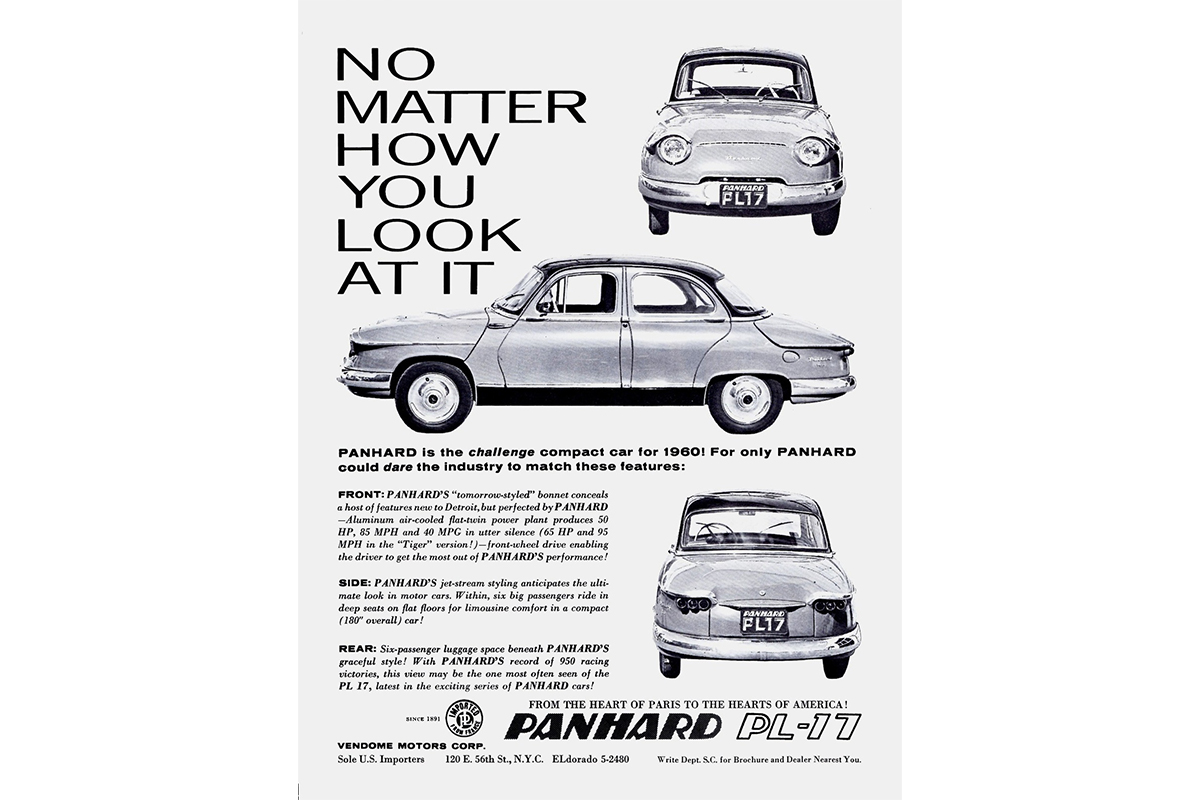
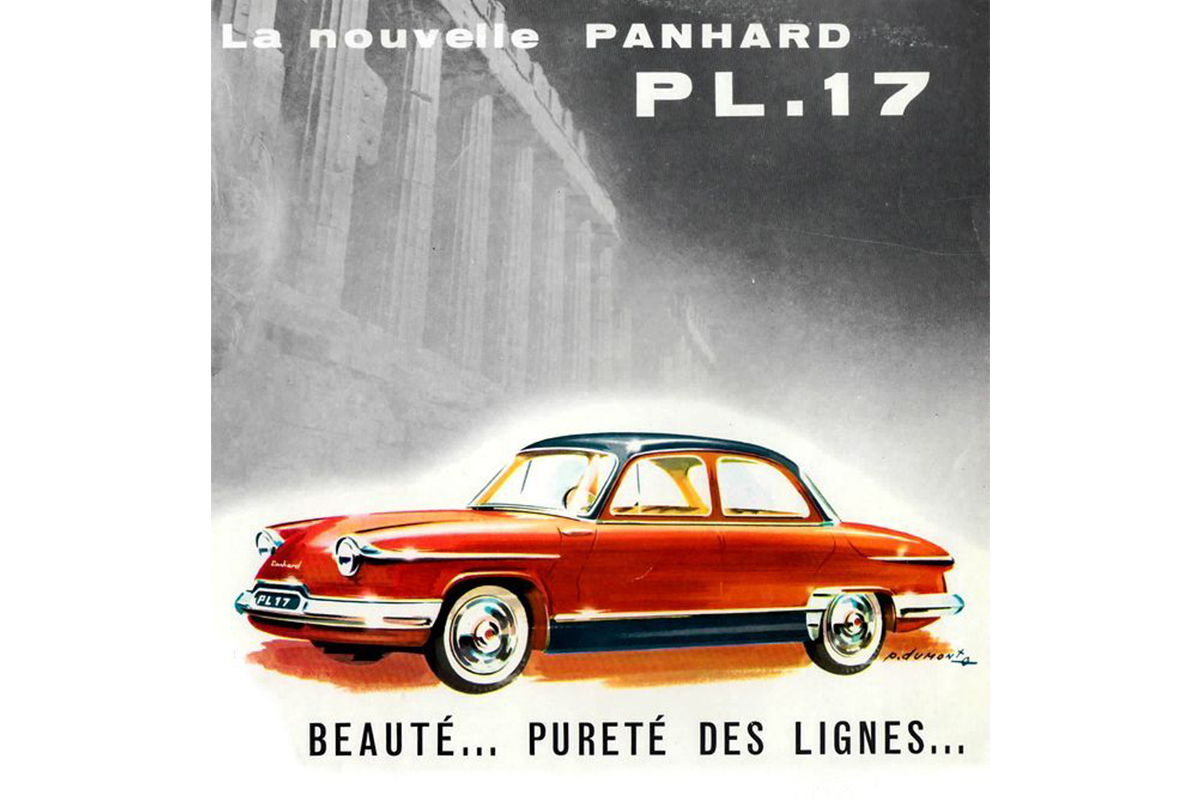
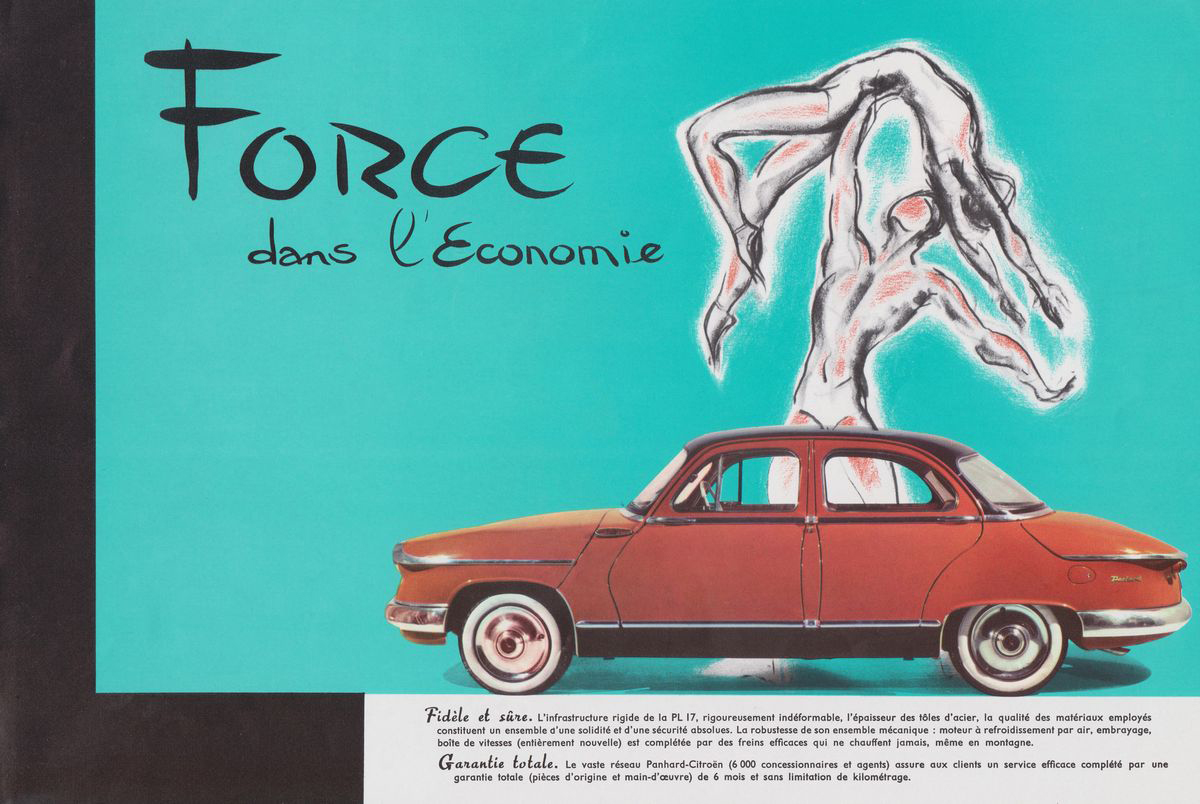
The Panhard Dyna ended after the 1959 model year, replaced by the PL 17. Though sales literature no longer used the Dyna name, it was quite evident that the 1960 model was little more than a facelift of the familiar Dyna. At the front, the oval mouth was gone, replaced by a horizontal slot above the bumper, and over the headlights the PL 17 grew a polished aluminum “eyebrow” that reached across the hood and back along each fender to behind the front wheel well. The rear was changed as well, with bright-edged horizontal fins over the taillights. It was obviously a Dyna that had compromised its engineering integrity to the whims of fashion.
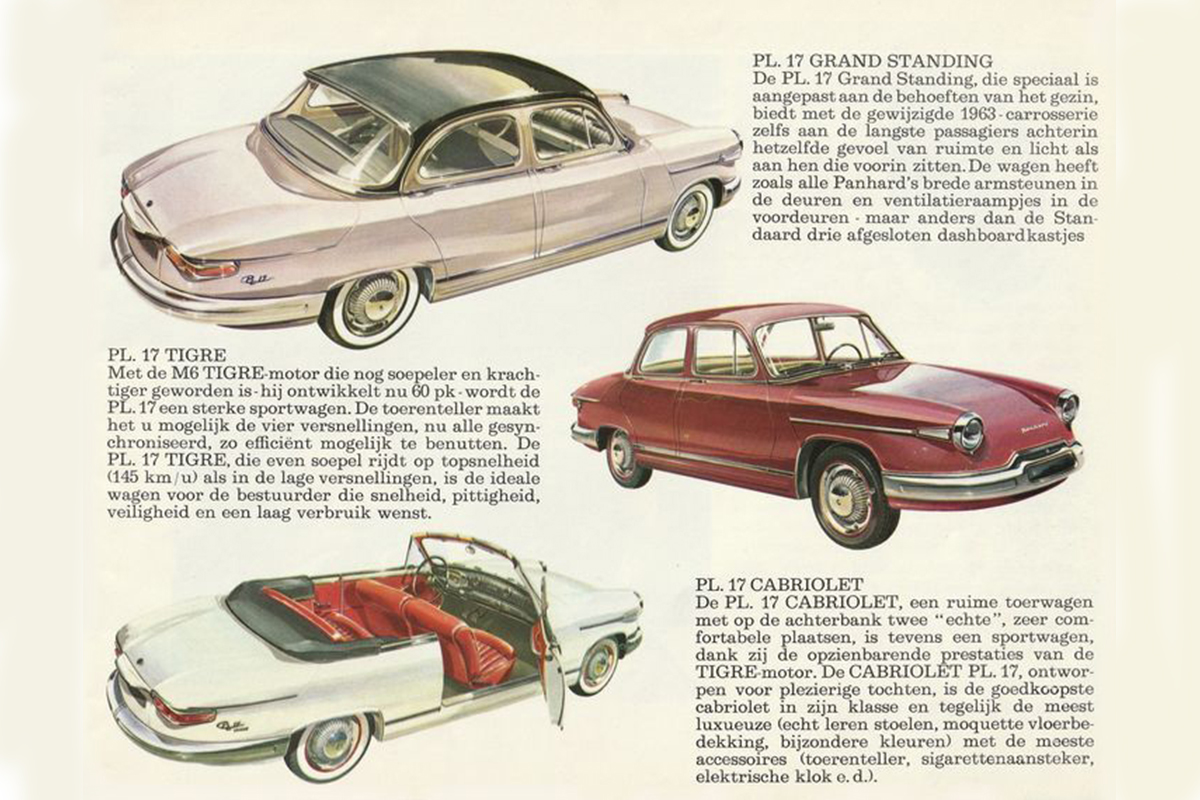
Panhard offered various versions of the PL 17 in 1960. The Luxe was quite literally a “stripper,” devoid of most of the trim, while the Grand Standing continued its upscale position with two-tone paint – including colors as dreadful as anything on the American market. The “Jaeger coupler” was still optional. If the Tigre motor was specified, the seats were covered in simulated Tigre skin! The van (fourgonette) and small truck (camionette) as well as pickup versions were available. Despite the lack of mechanical changes for 1960, sales rebounded to 34,050, not far from the 1957 record sales figure.
A PL 17 was tested by Foreign Cars Illustrated and Auto Sport, which didn’t comment on the new styling and made note of the ‘Frivolous Fuchsia” color of its test car while decrying the liberal use of plastics in the interior – “the only objections we had.” The magazine touted the car’s ride, handling, heater(!), lack of rattles and economical operation, and said while “the horsepower-weight ratio is rather dull, but performance… is more than adequate.” Acceleration tests put 0-60 mph at 22.3 seconds.
History originally published in Automobile Quarterly, Volume 32, Number 1; Fall 1993. Republished by author John Matras.
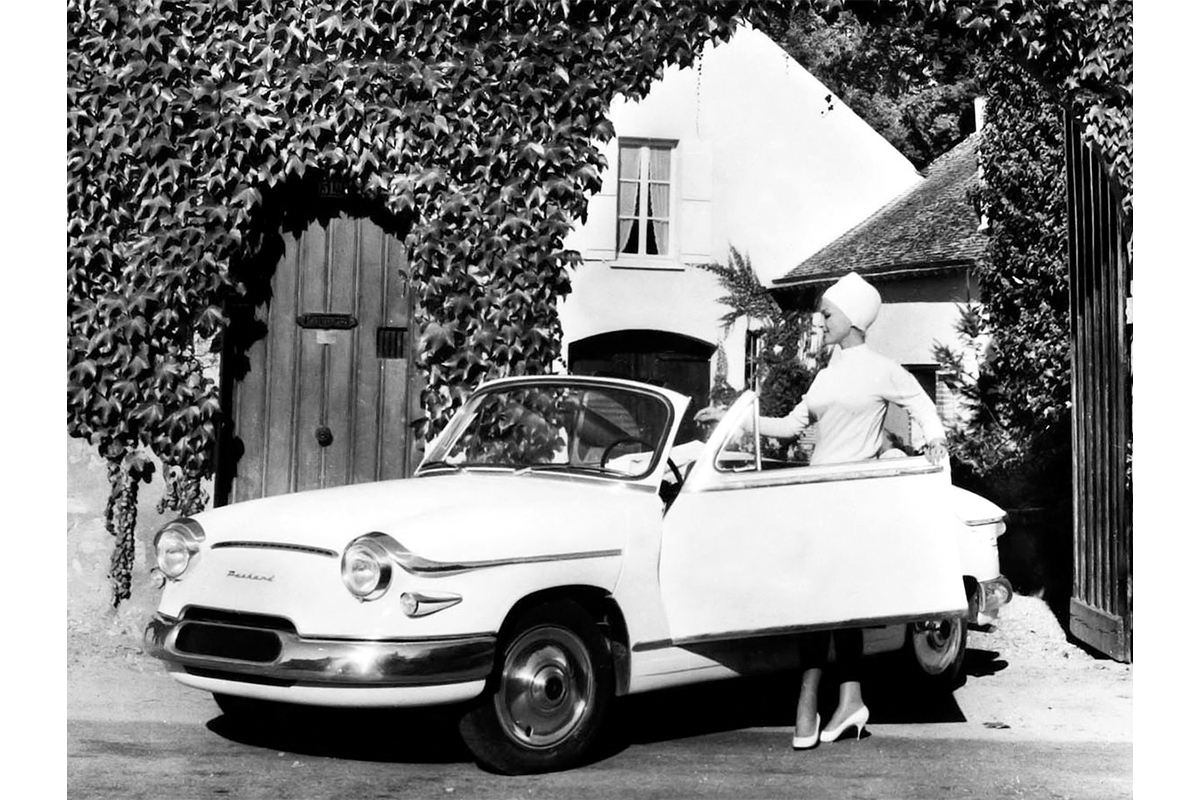
For 1961, Panhard played with the trim and models again, introducing a Grand Luxe package between the Luxe and Grand Standing. More importantly, the front doors were changed to conventional front hinges. A cabriolet was available after a year’s absence, while the Cabriolet Tigre and the utility versions continued as well.
There were more details changes in 1962 as well as the addition of a “Relmax” trim option. A contraction of relaxe maximum, Relmax included individual fully-reclining seats, velour fabric and such. Previously even the Grand Standing had vinyl seats. After slipping in 1961, sales were up to 33,698 cars for 1962.
In 1963, displacement went down slightly (from an actual 851cc to 848cc) but horsepower rose to 50 (60 for the Tigre B). A new and improved competition-bred transmission was installed as were new light-alloy brake drums that not only dissipated heat but looked racy. The eyebrows over the headlights were shaved, giving a cleaner look, with turn signals placed alongside the headlights. The peculiar little half-moon instrument panel disappeared as well, though its replacement, as arc-shaped speedometer surrounded by hood, was not particularly beautiful. And, after many years without one, Panhard offered a station wagon.
An interesting variant appeared in April 1963. Based on the Le Mans 1962 index-winning coupe designed and fielded by Charles Deutsch (after Bonnet had gone his own way), the Panhard CD was in truth successor to the DB, a high-performance 2+2 coupe that could be raced and yet was suitable for road use. Its profile owed more to aerodynamics than style, but it proved to be the fastest Panhard ever, capable in Grand Tourisme trim(60 hp) of 100 mph. In Rallye trim (twin carburetors and 60+ hp), it could turn almost 110 mph. The fiberglass-bodied coupe was catalogued by Panhard, and some 160 were built. The CD was a fitting legacy to Panhard’s racing record, being both its fastest model and last ever to win (1962) or race (1964, further streamlined and even supercharged) at Le Man.
Panhard 17 – The pL disappears
The next year would be the last ever for the PL 17, and the final Panhard sedan. The sedan had a name change as well, the PL designation was dropped and model designation changed. The base model became the 17 b Luxe, the 17 b Super X took the place of the PL 17 Grand Luxe, the 17 b Relmax replaced the Grand Standing, and the 17 BT Relmax Tigre used the 60hp engine. A 17 Break (station wagon) was produced as well. Production ended in January 1965.
Panhard 24 – Panhard’s last chance car
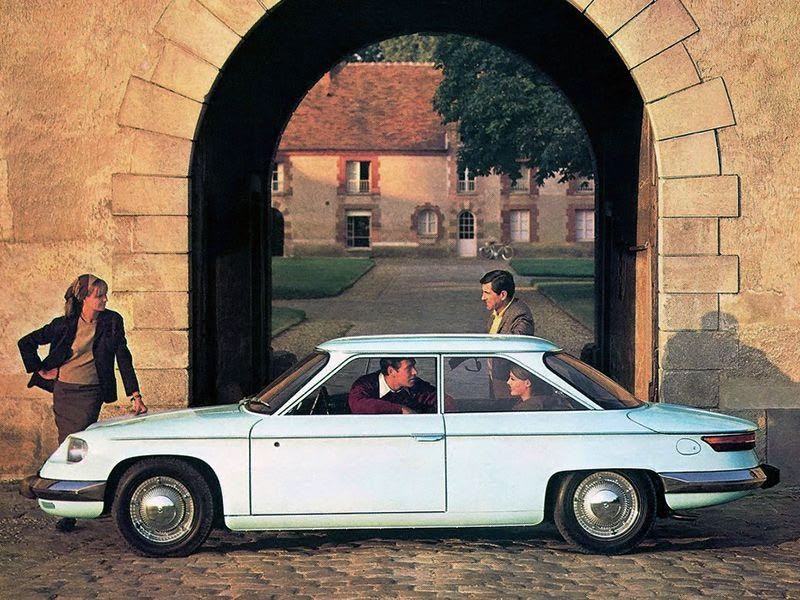
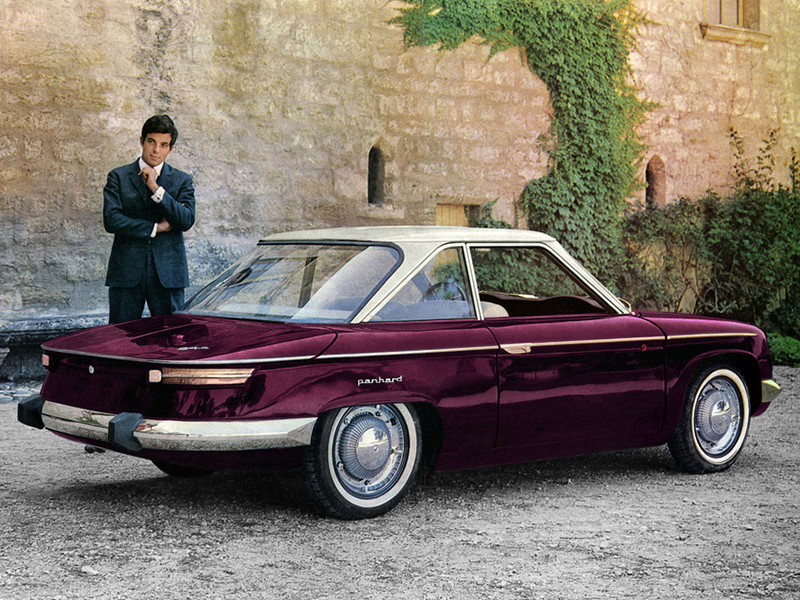
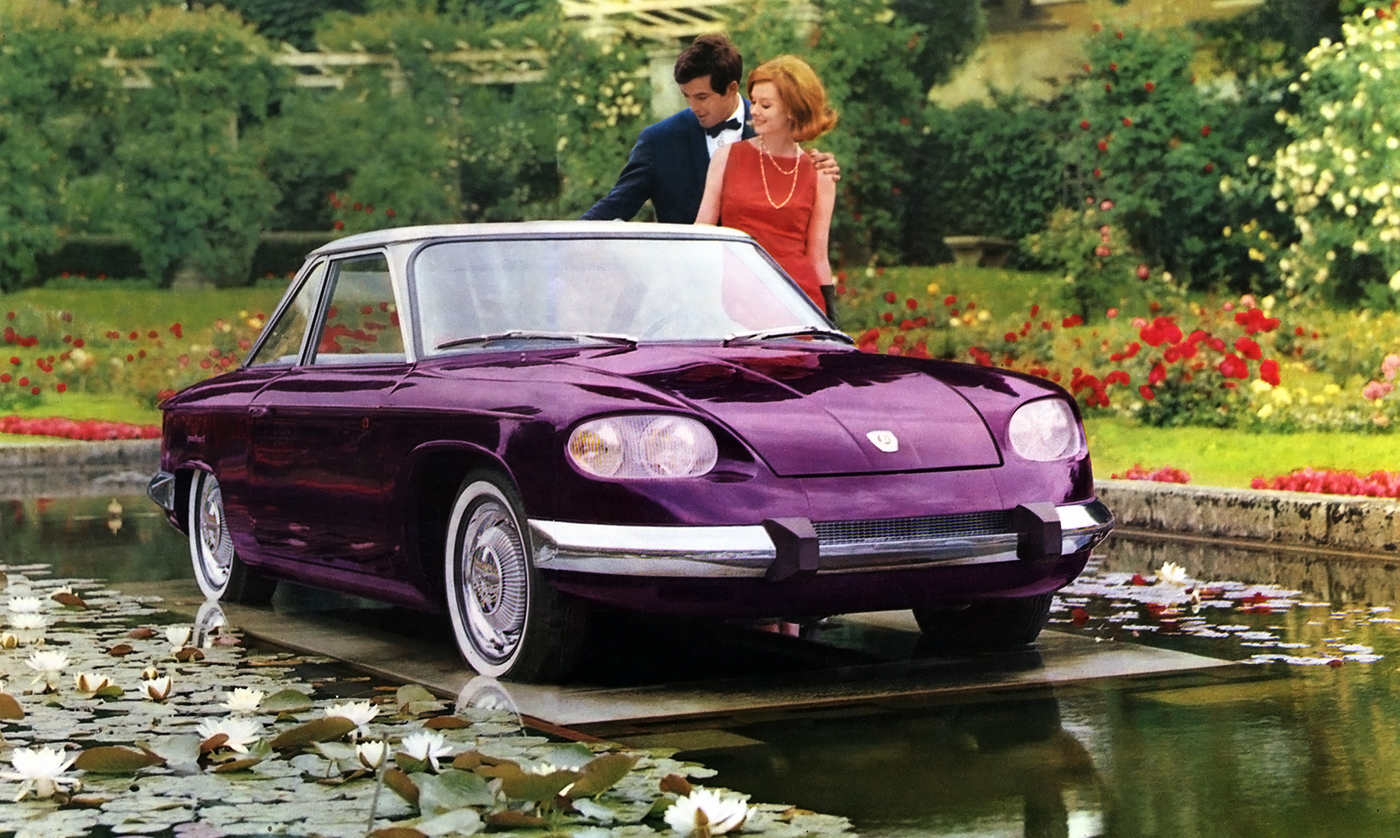
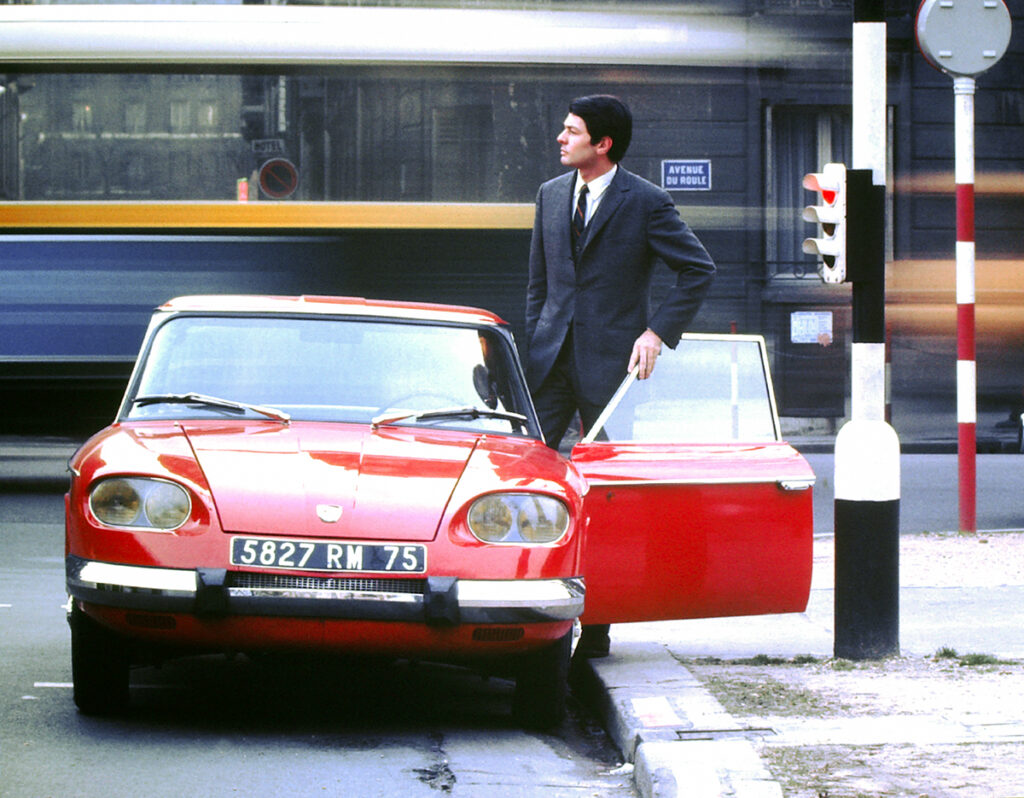
The 17 had, at any rate, been eclipsed by the new two-door coupe which was to be Panhard’s last hurrah. It was still built around the flat twin that some 20 years earlier and many modifications before, had powered the VP2 prototype. And like the original Dyna X and Dyna Z cars, it had been designed by Louis Bionier. It was a thoroughly contemporary shape with an airy greenhouse and unmistakably Citröen-esque features. No doubt Panhard’s Parisian partner influenced various engineering features, such as the struts inside the A- and C-pillars that rigidly supported its roof. The new model went on the market in the fall of 1963 and was called the 24, with the 24 c equipped with the standard 50 hp engine and the 24 ct powered by the 60 HP Tigre twin.
Refinements in midyear edged horsepower and top speed upwards, yet L’ Automobile considered the cars brakes and road holding to be its best features. Its styling, however, was praised in a way that needs no translation: “elégante, personalisée et harmonieuse.”
The 1965 models debuted in the fall of 1964. Panhard stretched the wheelbase of the 24 to create the 24 b and 24 bt which, though still only two-doors, were true four passenger sedans. The approximately 10-inch increase in length was completely behind the rear edge of the door and in front of the rear wheel opening and was so well executed that the short and long wheelbase models almost had to be viewed side by side to be noticable. The 24 c was dropped, while the 24 ct continued with more horsepower and disc brakes, as did the 24 b and 24 bt. While the Tigre-engined models had sporty instrument panels with a round speedometer and tachometer, the 24 b had a more sedan-like speedometer. The Tigre engine itself underwent yet one more revision, and along with a taller fourth gear, top speed of the 24 ct was bumped up to 96 mph
There was yet another model for the Panhard line in 1966, the 24 ba, a long wheelbase model with a simplified interior and spare exterior trim. More significant, however, was that this new model, along with the rest of the Panhard 24 line, was now a part of the Citröen line. Citrŏen had acquired the remaining shares of Panhard during 1965. Jean Panhard, who had taken the helm of the firm from his father Paul, saw the sale as a necessity. Although Panhard had projects underway – a longer 24 with four doors, a high-performance coupe to replace the cd ending new very compact narrow-angle X-4 air-cooled engine – it did not have the resources to take these studies to production status.
Tne end of an auto Giant
Alas, Citröen’s agenda did not include the production of an expanded Panhard line. Indeed Citröen primarily intended to acquire the manufacturing facility to produce for itself the 2CV that Panhard had been building. Sales of Panhard models declined to 11,631 in 1965. In 1966, only 3,845 units were sold, in 1967, a mere 1,426. While the Panhard 24 was a mostly contemporary design, the engine was short on power and, despite the considerable ingenuity that had gone into its development, the twin-cylinder layout lacked the refinement buyers had come to expect.
Eventually, Citröen made the decision to terminate Panhard’s production of automobiles. On July 20, 1967, in metallic-blue 24 b with a black interior rolled off the production line at l’ avenue d’Ivry. It was the last Panhard automobile ever built. Jean Panhard optimistically noted, however, that all was not completely lost – Panhard employees retained their jobs. When Citröen acquired Panhard, it established the Société de Construction Mécanique Panhard et Lavassor under Jean Panhard to take over Panhard’s ongoing manufacture of military armored cars.
The end of Panhard at Levassor as a car builder was, perhaps, inevitable. Rovin had succumbed in 1959, and Citröen would later merge with Peugeot. The Dyna and successors, which were truly Dyna is in everything but name, and saved the grande dame of French automakers after World War II. The engines of Delagarde and chassis of Bionier were remarkable designs which resulted in, as Panhard’s sales literature called the Dyna Z, “the car that made sense.” But by the mid-Sixies they had outlived even their extraordinary capabilities. The Dyna had served Panhard well for many years, but the era of twin-powered sedans was over at last. It was prosperity, not war, this changed Europe once again. But this time, Panhard et Lavassor could not change with it.
Addendum: The Panhard PL 17, Panhard 17 and Panhard 24 succeeded the Dyna Panhard. The history of the Dyna, as well as the origins of Panhard et Levassor is covered here.
Want to know how the horizontally-opposed twin engine of the Dyna Panhard sounds running. Check this video. Or here to hear it running with mufflers. And for the Dyna engine running with mufflers.