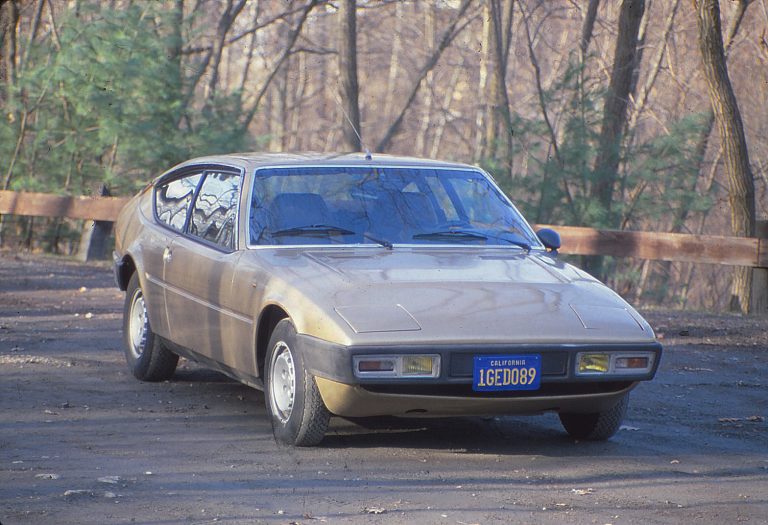


Mercury LN7 doesn’t exactly roll off the tongue. does it? Still, it did fit Mercury’s nomenclature. The XR-7 had been the upmarket version of the Cougar since when, about 1967? So, to create a sporty version of the Lynx, subtract to the consonants (sorry, Vanna) and borrow the 7, then add it up for a sporty, two-seat front-wheel-drive car. The Mercury Lynx, of course, was the Ford Escort the Mercury dealers got to sell, and the Escort was a long-awaited three-billion-dollar front-wheel-drive replacement for the Pinto.
While the Ford Escort and Mercury Lynx were both 1981 models, the debut of the Mercury LN7 and its clone-in-law, the Ford EXP – the sporty rendering of the Escort – was delayed until April, appearing as early 1982 models. The Mercury LN7 shared all major specifications with its Ford kin, which didn’t differ significantly from their sedan origins. The wheelbase was an identical 94.2 inches with McPherson struts up front, and the rear had a strut-type suspension with a lower control arm on each side. Indicative of the time, standard tires were dainty P165/80R13s with European wrap-around tread patterns on styled steel wheels. There was also an optional suspension system keyed to Michelin TRX-type steel-belted radials that was introduced on the 1979 Mercury Capri. The tires were mounted on metric-sized alloy wheels, 365×135 mm (14.4×5.3 inches), and carried a peculiar P165/70R365 designation. The TRX tuned suspension had variable spring rates which were developed for use on some of Ford’s European sports cars, along with different bushings, shock absorber turning and a larger 26mm diameter front anti-rollbar.
History originally published in Sport Compact Car July, 1997: republished by author John Matras
The four-door body of the Escort/Lynx was replaced with one having the look of a shrunken Mustang/Capri from the belt line up, but peculiar goggle-eyed headlamp treatment spoiled any chance of being elegant. Looking like a Pac-Man swallowing a rectangular headlamp, this lighting treatment was contrary to intuitive aerodynamics, although the Mercury LN7 had a drag coefficient of 0.36. At the time it was good enough to be called “slippery,” which was better, for example, the contemporary VW Sirocco. The LN7 was the best, Mercury claimed, “of any standard-equipped American-built car,” which enhanced “both high-speed stability and fuel economy.” A distinctive feature of the LN7 was the “bubble back” hatch, a theme borrowed from the contemporary Mercury Capri.
The hatch opened to a 34-cubic-foot interior. That’s a total; Mercury didn’t claim a separate luggage capacity. Mercury also provided seating – well-bolstered vinyl and fabric buckets – for two, although a back seat could be ordered through the dealer if anyone knew to ask for it. It was an option Mercury was wise not to advertise as it was too cramped for even children to use. Motor Trend praised the quality of the interior plastic, while Car and Driver called the dash “tackier than fresh paint, rife with cheap-looking panels, and chrome that bleeds vaguely into the surrounding blackness.”
During its first year, Mercury LN7 buyers had the option of Ford’s new four-speed transaxle (built by Toyo Kogyo – Mazda – in Japan) or the three-speed “split Torque” ATX automatic transaxle, although the latter would be a disaster with the meager output of the 1.6-liter SOHC four-cylinder engine. Introduced in the 1981 Escort/Lynx, the Compound Valve-angle Hemispherical (CDH) engine produced a mere 70 hp, low even for then, and Motor Trend’s testing yielded a 0-60 mph time of 14.21 seconds and quarter-mile of 19.64. On the other hand, Mercury claimed the LN7 had a “tuned” exhaust system that boosts performance at highway speeds and as a sporty “throatiness.” An optional performance ratio of 4.05:1 was available with a standard transmission, although that would have played havoc with the EPA mileage ratings of 29/46 MPG (Motor Trend got six MPG in real-world use).
The savants of Dearborn predicted success for the LN7 based on the number of single and two-person households, along with the fact that four out of every 10 Ford cars were being sold to women. Mercury General Manager Gordon Mackenzie said, “the Mercury LN7 satisfies all of these emergent demographic trends – and then some.” But apparently the Mercury LN7 didn’t satisfy buyers, who failed to roll trippingly into Mercury dealerships. When roll was called in 1984, Ford’s EXP came equipped with a five-speed manual transmission, the LN7’s bubble-back rear window, and optional turbocharging. The Mercury LN7, however, was missing in action.
Addendum: Ford Motor Company, like a number of other car manufacturers, jumped into the 24 Hours of Nelson Ledges. This race for Sports Car Club of America “showroom stock” cars—cars as made by the manufacturers with the only changes things like rollbars for safety—had received a lot of attention in its first year, so it looked like cheap and easy publicity for the car companies. Even Porsche was into it with its new Porsche 924. Ford prepared cars for two automotive magazines, a Mercury LN7 for Road & Track and a Ford EXP for Car and Driver. If you build it, they will come. And for the LN7, it meant a third place overall placement. Alas, race on Sunday didn’t mean sell on Monday for the Mercury sportster.
More Mercury on RememberRoad? Look it up here.