

You know the BMW M1. You know about Project E26, BMW’s foray into exotica, its attempted strike against domestic competition rival Porsche in Group 4. You know about its dalliance with Lamborghini, how the Italian carmaker was under contract to build the bodies because BMW Motorsport lacked suitable construction facilities. You know how the bodies and interiors had been penned by Giugiaro and his staff at Ital Design.
You know that Lamborghini, with problems of its own, was yanked from the project and the construction handed out hither and yon and all production deadlines were missed and by the time the M1 was homologated for Group 4 (400 cars built) the silhouette class had come and gone. I shouldn’t have to tell you about ProCar, the IROC-like series that pitted top F1 stars against moneyed and willing sportsmen, and you might even know that the M1’s only real racing success came in 1981, when Dave Cowart drove the Red Lobster M1 to an IMSA GTO championship, and that Knepper Miller, who shared that car with Cowart, took second and that nine of the top 10 positions in GTO went to M1 drivers.
You probably know that the M1 carried its 3.5 liter six-cylinder engine amidship and that the engine was the first to carry BMW’s dohc four valves per cylinder head, that the street and race versions alike had Kugelfisher-Bosch mechanical injection and Magnetti Marelli crank-fired breakerless ignition; that the street version made 277 hp at 6500 rpm and 239 lbs ft at 5000 rpm while the racer produced 470 bhp at 9000 rpm and 282 lbs-ft of torque at 7000 rpm. You might even know that the two-seat German sportster had a fiberglass body only 44-inches high and a curb weight of 2867 lbs and competition ready unequal-length A-arm suspension at both ends and four-wheel disc brakes.
And you most likely know that BMW took a bath on the M1, losing a reputed $250,000 on each one despite an approximate $50,000 selling price and reportedly costing then BMW Motorsport honcho – and M1 godfather – Jochen Neerpasch his position. But BMW gained untold “free” advertising in the automotive press and at racetracks around the world.
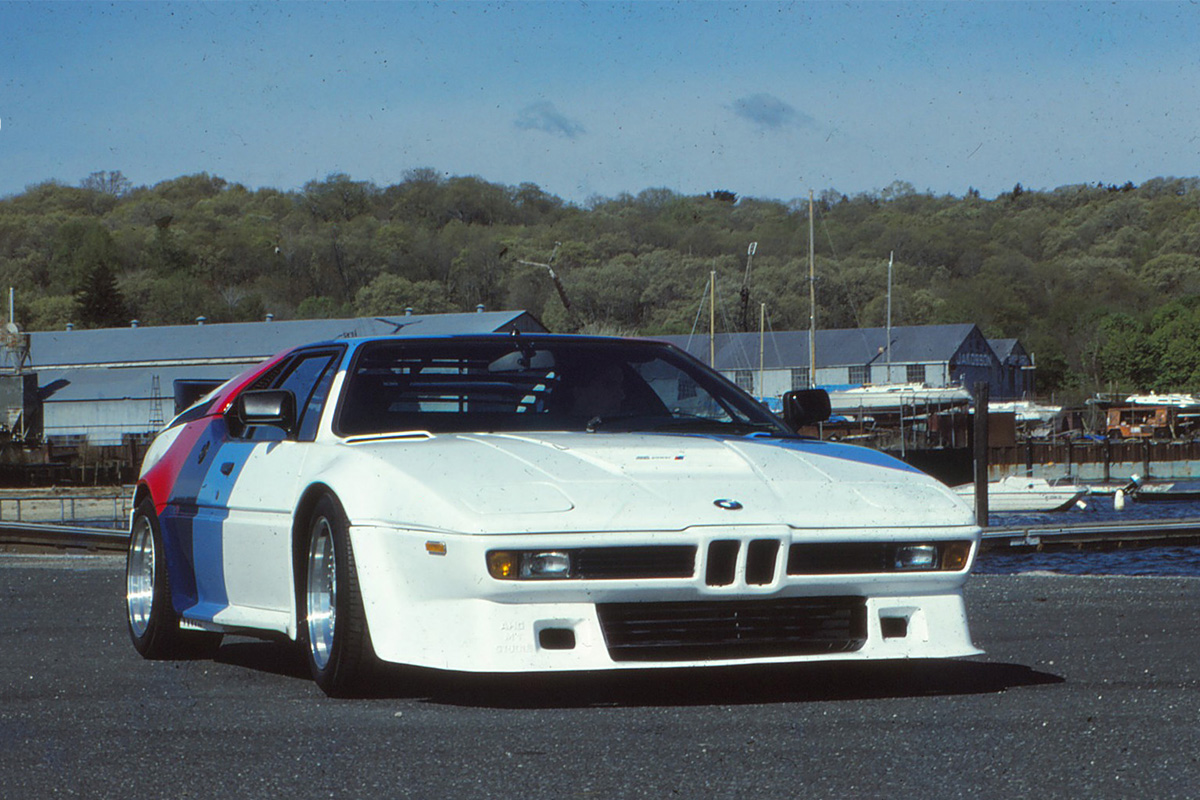
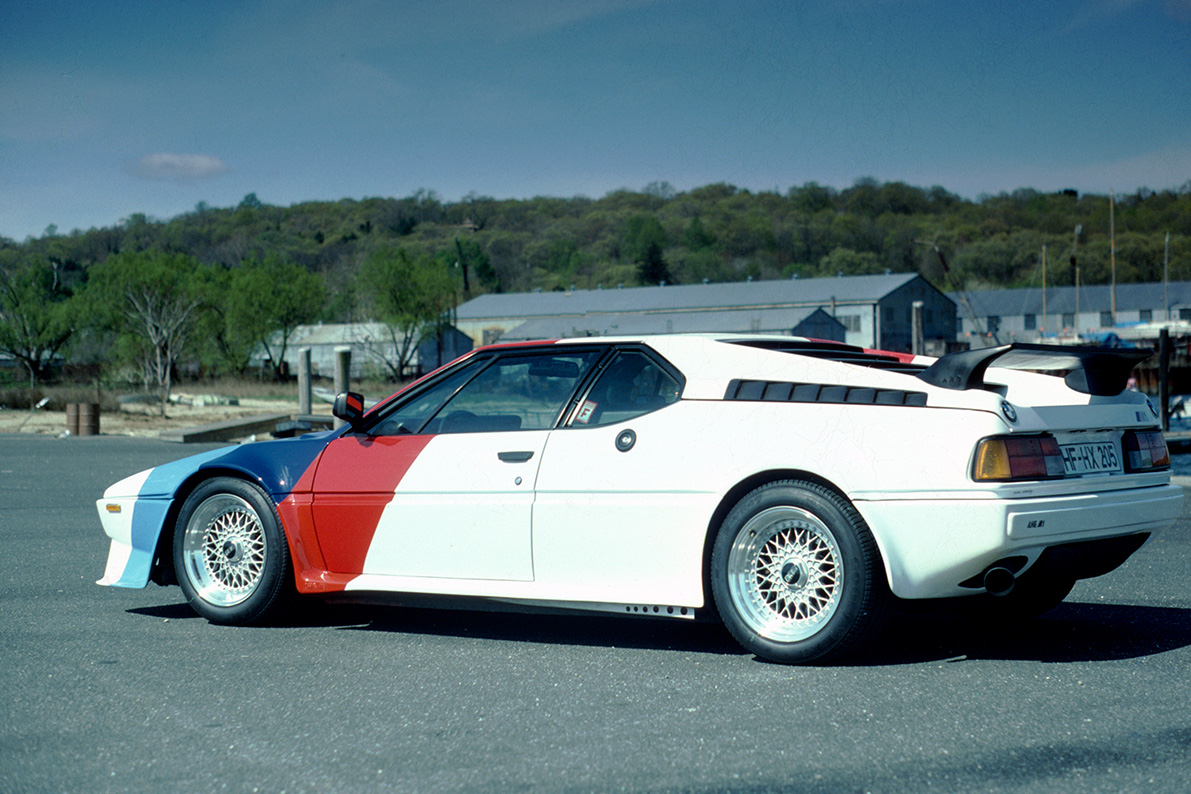
But what you may not know is that BMW commissioned AHG, a large BMW dealership and distributor more famous perhaps for a sideline of tuning BMWs, to build a trio of Kevlar-bodied M1s to evaluate the potential of the space-age material for production use.
AHG did more than produce mundane test vehicles, however. The three Kevlar BMW M1 cars were fitted with wheel flares and the “aero” rocker panels, chin spoilers and rear wings that gave the cars a much more ProCar look. Unlike the race-class cars, the modifications were smoothly integrated into the bodywork rather than just being tacked on and the rear wing was much smaller than the huge flyer mounted to the rear of the racers (which, incidentally, provided too much downforce, but were required for racing because that was how the cars were homologated – even though their use on the street was prohibited by law). Under the flares went wide 245/50 Goodyear tires on three-piece 11-inch wide BBS wheels and the engines were tuned by AHG to produce a racer-like 470 HP.
Inside, the rather stark M1 interior with its black-and-white checkered seat inserts was replaced with show quality leather. And outside, custom paint was designed by Ernst Fuchs, one of Austria’s most famous artists: one was blue with psychedelic asymmetric laid-out silver stripes that would do a Kalifornia Kustom painter proud, another was white with diagonal BMW Motorsport stripes, and the third was red. All three still exist. Two are in the US, the blue car at last report owned by a Detroit collector, the white car in a private collection in Atlanta. The red one is in Europe undergoing reconstruction after a fire.
Of course, you know I’m going to tell you how it is to drive one of them. First off, you have to know that the M1 is one of the best handling road cars ever made, as its racecar origins and layout might lead you to believe. It is utterly predictable, can be tossed about or even driven with surgical precision, pushed and pitched or guided like silk through the eye of a needle. It is zipper-quick in acceleration and swift on top end to 160 MPH.
So the Kevlar BMW M1: I drove the white one, then belonging to Ingo Theune of Oyster Bay, New York. It was everything the standard M1 was, more and less. The handling was still there and cornering force doubtlessly improved, but the wide tires would frequently rub against the flares. And the power, how does one measure the difference between 277 and 477 hp without an autobahn or racetrack? Prudence prohibited a full exhibition of thrust – but it should also be noted that the motor was also exceptionally well-behaved in traffic and idles like a sewing machine. To be certain, the Kevlar M1 is less practical than the standard version. You know, though, that practicality has little to do with lust.
But you know, however, that it has a lot to do with business. It was simply too much, too soon. Though some of the ProCars had bits of the miracle material, Kevlar was not used on production M1s. The Kevlar M1’s went on become show cars and pace cars and eventually collector’s items.
Which now you know.
Addendum: See more BMWs on Remember Road.