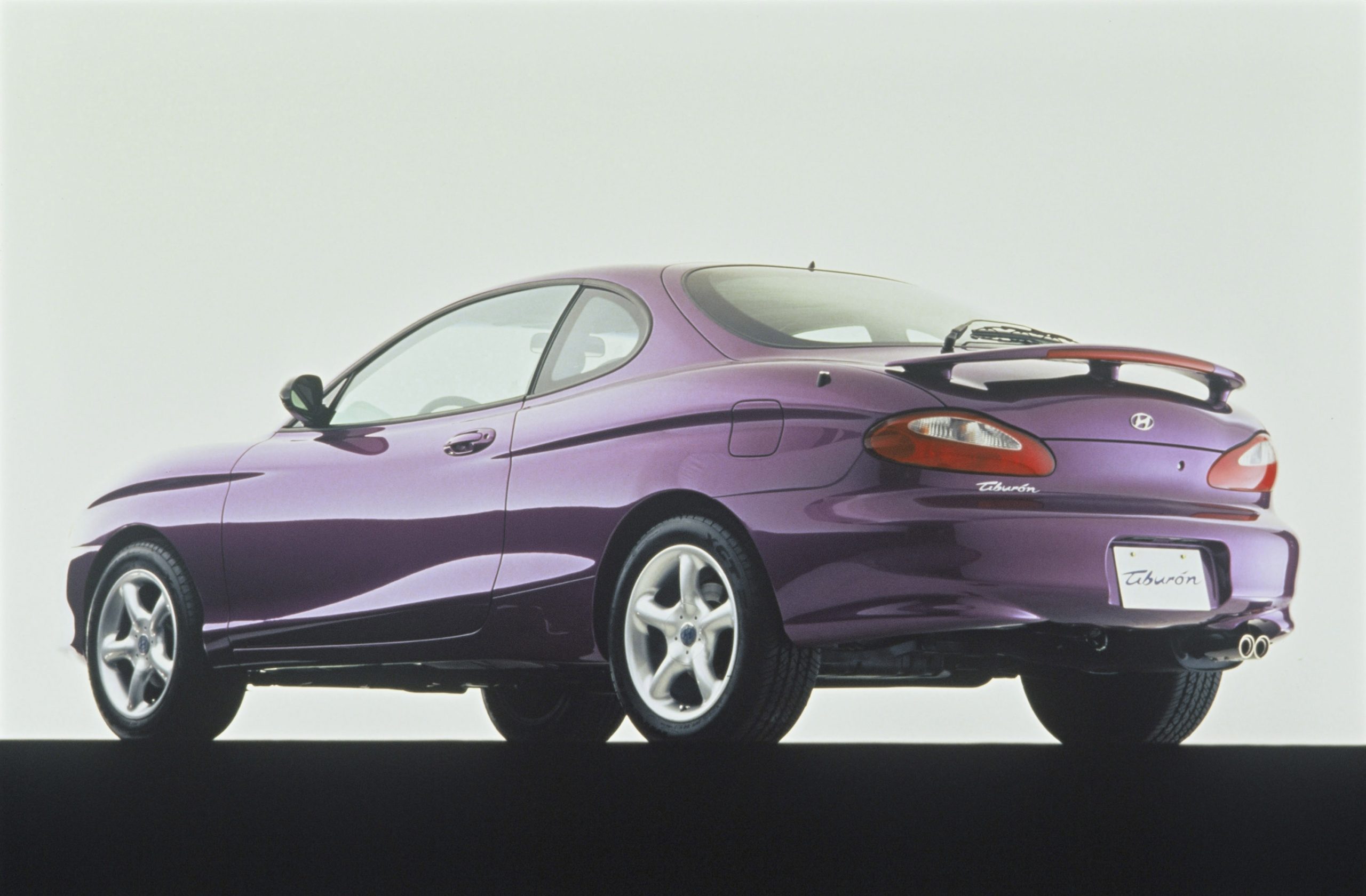


Arriving fall 1996. That’s perhaps the best thing we can say about the Hyundai Tiburon. The Korean carmaker put a show car version on display at the New York auto show in April and, according to Jim Hossack, Hyundai’s vice president of product planning, “there will be no sheet-metal changes” before the car debuts in the autumn of 1996 as a 1997 model. And no sheet plastic changes either.
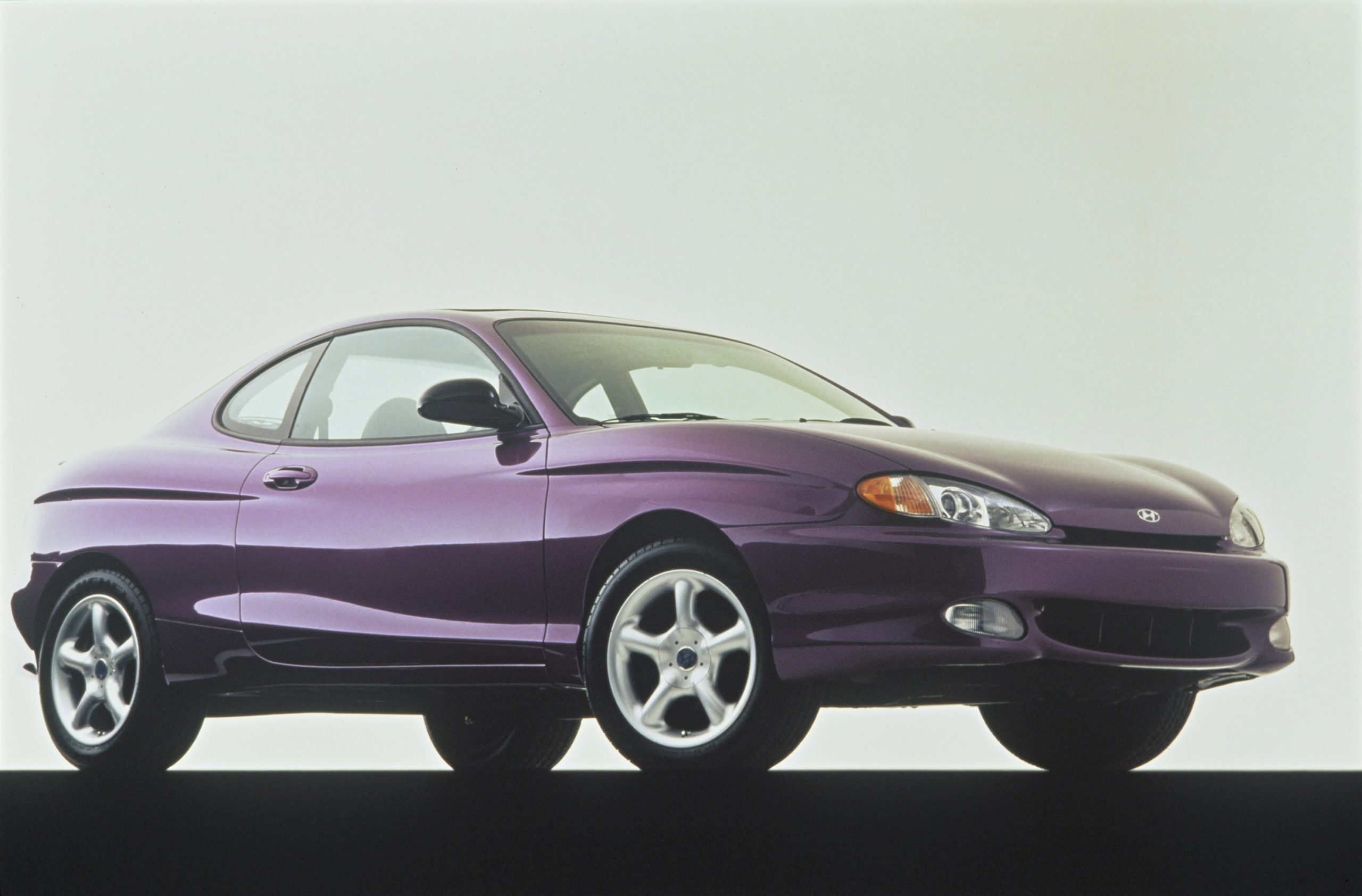
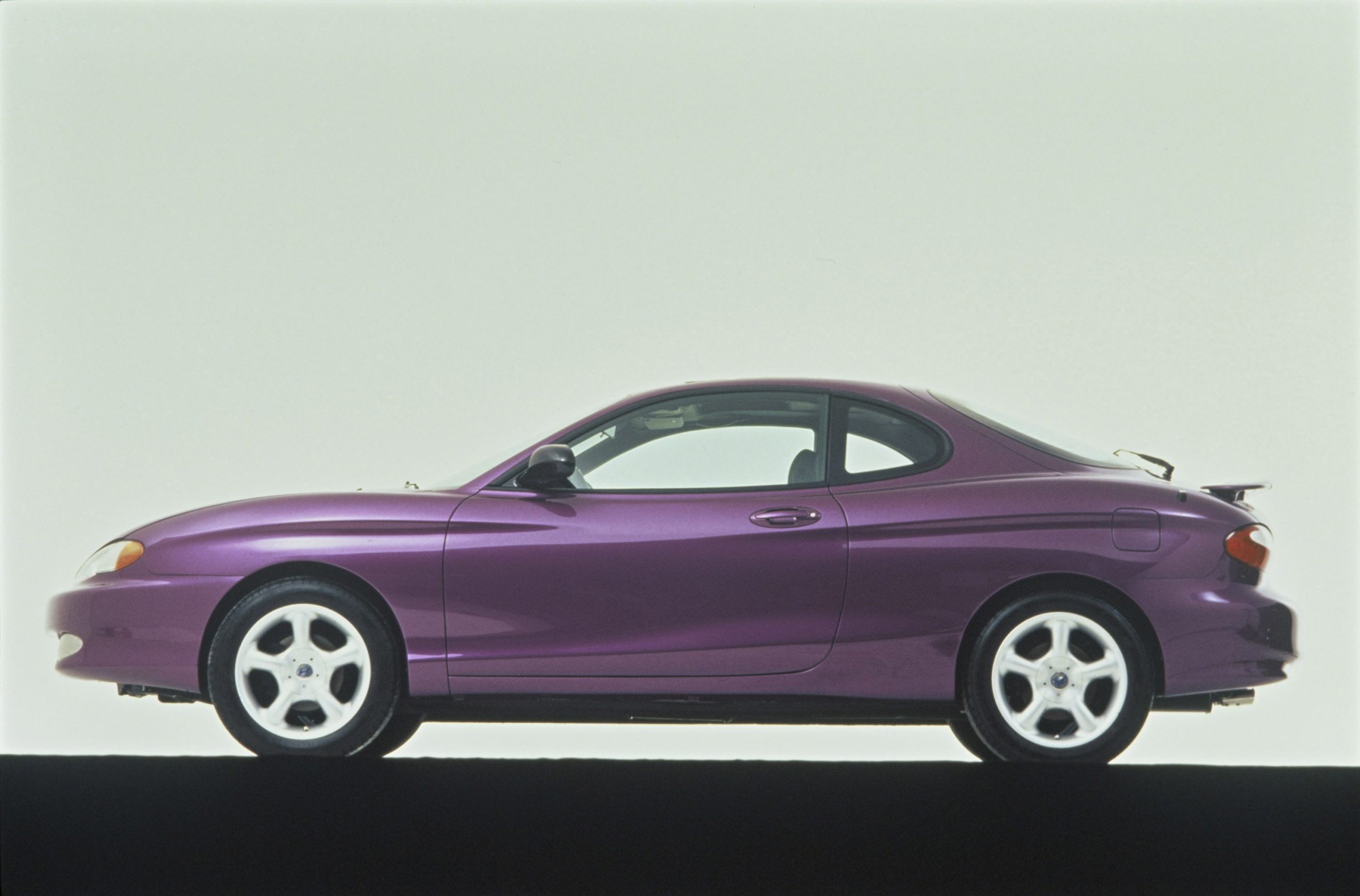
That means in the very few months you will be able to buy virtually what you see now, a muscular profile etched with definition. Instead of a common amorphous and anonymous shape, Hyundai American design center gave the Tiburon – Spanish for shark – highly delineated front and rear fenders distinguished by blisters at the fenders upper edge. The aero headlamps merge with the upper contour of the front fenders which wrap over the sides of the hood which bulges upward in the middle.
Originally published in Sport Compact Car, August 1996, republished by the author.
There is some interesting shaping down around the chin area, and on the show car, aero-lensed fog lamps are integrated into the air dam that contains the primary radiator inlet. Hossack promises the projector-type low beams will continue on the production Tiburon, too.
The sides of the car stops just short of busy, while the rear has a distinct flavor of Pontiac with the spoiler from the Mazda MX-3. The rear hatch is not quite fastback – though a rear wiper will be available – and not quite a notch. It’s an enthusiastic design that will be easy for conservative stylist to criticize – but then, what did they know about fun? “It’s the fulfillment of a promise,” says Hossack, made by the HCD-II show car that debuted at the Detroit auto show three years ago to rave reviews.
The eager styling of the exterior continues inside. Hyundai designers tried hard to create the feel of a “cockpit” and largely succeeded, though the result resembles the cabin of the Mitsubishi Eclipse but with less restraint. The instrument panel with canted center dashboard vents and other contouring focuses on the driver, although the corner dash vents are actually sculpted into the door panels. The gauges themselves will put off traditionalists: 140 mph speedometer is – like the Toyota Prius – oval, and the tachometer to the left and combination fuel and temperature gauges plus warning lights to the right are oval as well, set into the sides of the speedometer. The brow over the instruments is contoured into the tops of these ovals. Different – but analog gauges, I think, look weird and a little too George Jetson are anything but round.
Seating position is good, the seats covered in leather and for enthusiastic driving, nicely bolstered – racing does improve the breed – and there’s an honest-to-goodness dead pedal for bracing yourself during said maneuvers. Someone’s been paying attention. As for the back seat, well, this is a sport coupe, not a limo, and if you’re the driver, you’ll never ride back there anyway.
The Tiburon is based on the 1996 Elantra platform, Hyundai’s midsize (between the Accent and the Sonata) sedan, though with the wheelbase shortened to 97.4 inches, three less than the Elantra’s. Suspension is fully independent, with MacPherson struts up front and a dual link design at the rear. Brakes, naturally, are four wheel disc with ABS. Wheels and tires are most subject to change for the production model, but on the show car, Hyundai installed Michelin XGT4 high performance 215/55R-16 tires on five spoke alloy wheels. Hyundai claims the Tiburon chassis has been “sport-tuned for optimal handling and control,” and though first drives of the Elantra have proven it to be a good handling sedan, we’ll have to wait for drive time to tell how well performance lives up to propaganda for the coupe.
Speaking of performance, the show car is fitted with Hyundai’s own “Beta” engine, a 2.0 liter four-cylinder with double overhead cams and four valves per cylinder. In the Elantra, a 1.8 litrer version of this whizzer is rated at 130-hp with 122 lb-ft of torque. That engine, with power and torque peaks at 6000 rpm and 5000 rpm, is a relative porker with 90 percent of peak torque available at 2300 rpm. Power ratings for the 2.0 liter in the Tiburon haven’t been announced yet, but a simple extrapolation puts output of the larger engine at 145-hp. We’ll see how that works out when the actual figures are released this fall. Regardless, it’s considerably more than even the turbocharged version of the Hyundai Scoupe, last seen in 1995 producing a mere 115-bhp – and buzzily at that.
Hyundai has been, in the words of Hyundai Motor America, “the kind of car people have to buy” instead of “the car they want to buy.” Tiburon should change that, more than be able to fend for itself in the sporty car world. The car, from the quality look the interior plastic to the projector beam headlights, says “value” rather than “cheap.” We look for prices in the mid-teens for a model fully equipped as the show car and less, naturally, for a base model. Kinda makes you wish the summer was over already, doesn’t it?
Addendum: The Hyundai Tiburon was a successor to and much improved over the Hyundai Scoupe.
Hyundai recounts the parental pride in Tiburon in an official reminicence on its international website, Car and Driver’s Steven Cole Smith gives it a glinty-eyed look in a contemporary review.