

Billowing rubber smoke, clouds of it, as if someone set off the smoke bombs! it was almost a genuine ‘60s smoky burnout, a muscle engine and low-grip tire sort of thing, except this smoke was rolling off the front tires.
I really hadn’t planned to do it. What I had wanted was to overcome turbo lag. The Pontiac Sunbird GT had oodles of power and lots of up and rolling acceleration. But with an automatic transmission it was bog slow off the line. But by torque loading – adding throttle while left-footing the braking – I had hoped to spin the turbocharger, adding a little boost for a stronger launch.
History/driving impressions originally published in Sport Compact Car, August 1996; republished by author John Matras
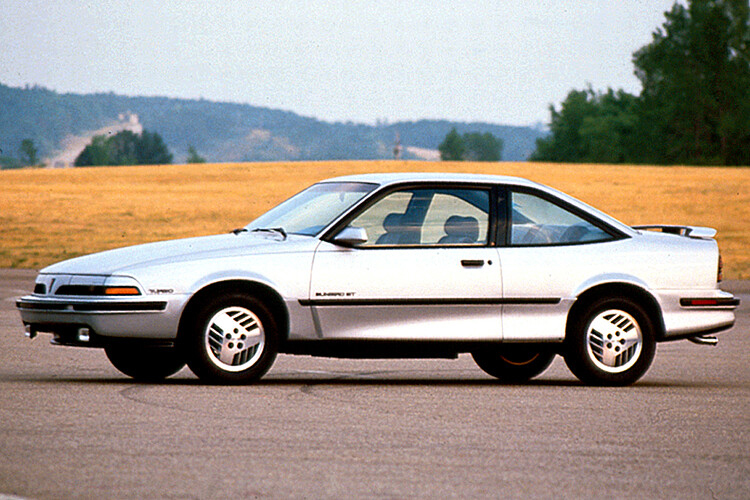
Surprise, surprise. With all the smoke of a Dateline segment. But the Pontiac Sunbird GT had always been full of surprises. The Sunbird name dated back to 1976 – a play on Firebird, of course – but had been dropped with the introduction of the General Motors J-car series. Pontiac, aping Japanese and European alphanumeric names, adopted the soulless J-2000 moniker or in 1982. The Pontiac Sunbird returned for 1984, but not until 1986 did the Sunbird, along with a facelift, gain the GT version, complete with its standard turbocharged engine and choice of four-speed manual or three speed automatic transmission.
As Greg Brown noted in Motor Trend, “it looks like a car with a lofty fun-to-derive quotient,” with spoilers and alloy wheels with wide 60-series tires, and its 1.8-liter 150-hp SOHC four was capable of a then-quick 8.25 second 0-60 mph blast, turning the quarter in 16.60 seconds. But despite bigger front and rear rollbars, stiffer springs and shocks, Brown said the Pontiac Sunbird GT’s front end’s geometry wasn’t up to the power delivered. “The front wheels are all over the place,” he wrote, “trying to bite for traction, steer, and generate accelerative forces all at the same time.” Try to put power down in corners and “torque steer is dramatically increased, and the car seemingly going sideways as much as forward.” It was, he said, neither sporty nor fun. At least the thrills, with a base $9,459 msrp, were cheap.
The very next year the Pontiac Sunbird GT’s turbo motor went to a full 2-liters and the extra displacement yielded 15 more horsepower, all the more reason to hold on tight when taking off. Remarkably soft on the bottom end, the 2.0-liter turbo made a mere 50-hp at 2000 rpm, climbing to 94 at 3000 and peaking at 165 at 5600 rpm, maxing out torque at 175 lb-ft at 4000 rpm. Keep those front wheels pointed straight ahead or be ready for very quick trip into the next lane. But 0-60 mph fell to 7.8 seconds and the quarter slipped by in a nifty 16.1 seconds at 86.9 mph.
The transverse-mounted engine looked the part of a modern horsepower factory, Pontiac dipping deep into the paint budget to slather the aluminum valve covers and intake plenum in a red that would make a stop sign blush. Even the tube from the front mounted intercooler had a cherry tent, though the valve cover and plenum had brushed aluminum accents that announce “2.0 OHC” and “TURBO” to anyone who might’ve forgotten. The turbocharger was a Garrett T25 with a liquid-cooled center bearing for longer life.
Transmission choice was between a Getrag five-speed and GM’s three-speed automatic. Motor Trend’s Ron Gable preferred the self-shifter with the turbo engine, the boost combining with a downshift to zap the Sunbird from one lane to another. Yet it could be tricky in curves. Consider a cloverleaf ramp: Feed a little throttle halfway through. That adds exhaust pressure, which spins the turbo, adding more power and ergo more exhaust pressure and so on, the old turbo rush. Well enough, but then the transmission downshifts, raising rpm – a lot with the three-speed – and therefore exhaust pressure and therefore more power and suddenly the Sunbird is zooming onto the outer shoulder. And all from just a little bit of throttle. It was hard to drive smoothly.
Motor Trend found the Sunbird capable of a “quite impressive” 0.87g on the skidpad, but this was countered by an “about average” performance in the slalom. This was attributed to a lack of “yaw stability.” Simply, the J-car McPherson struts and beam rear axle were the proverbial sow’s ear, designed for half the Sunbird GT’s power. Pontiac engineers could only do so much for a base price of $11,399.
The Pontiac Sunbird GT came with the 2.0 liter turbo motor to the 1990 model year, being replaced by the 140 hp V-6 for 1991, a more rational if less exciting engine. Sales plummeted. Pontiac reported the Sunbird GT as a separate model for’ 88-90 only, during which 25,947 were made, including 2,264 convertibles. They weren’t sophisticated, they weren’t grand, and for touring one might prefer something else. But the Sunbird GT wound the J-car rubber band about as tight as it would go. Let it loose and you were smokin’.
Addendum: Another contemporary review in Hot Rod Magazine which 1988 Pontiac Sunbird GT “a mini-muscle car in disguise.”For more sport compact cars in Remember Road, check out the1987 Renault GTA and the 1988-89 Chevrolet Beretta GTU.