

The Saab Sonett Super Sports, that Swedish fiberglass shingle, was a hit at the 1956 New York auto show, but only six would ever be built. It was not destined, nor even designed for serious production.
Yet the enthusiasm the original Sonett evoked was undeniable. Ralph Millet, president of Saab Motors, the Swedish company’s U.S. importer, believed that barring a real sports car, a high-performance version of the standard sedan would build showroom traffic to increase sales of standard Saabs as well as add sales directly with the vehicle for amateur racers and rally participants. Wins in competition would be free advertising that would lead to more sales, etc., etc. It was a sell on Monday, when on Sunday approach.
History originally published in European Car, July 1985; republished by author John Matras.
Happily enough, the home office bought the idea. A special model would be called the SaabGranturismo 750 and debuted at the New York auto show in April, 1958. The first shipment arrived at the docks in May. It was, in fact, special to the US, almost all Saab GT750s coming here. It would feature a more luxurious interior than the admittedly Spartan standard Saab 93, with badging, driving lamps and a pair of chrome strips along the rocker panels for identification. The heart of it, of course, was the motor. Saab already knew what worked with the two-stroke, winning the 1958 Swedish ice rally championships for Group III special production models, and essentially installed the replica of the race motor in the GT 750s.
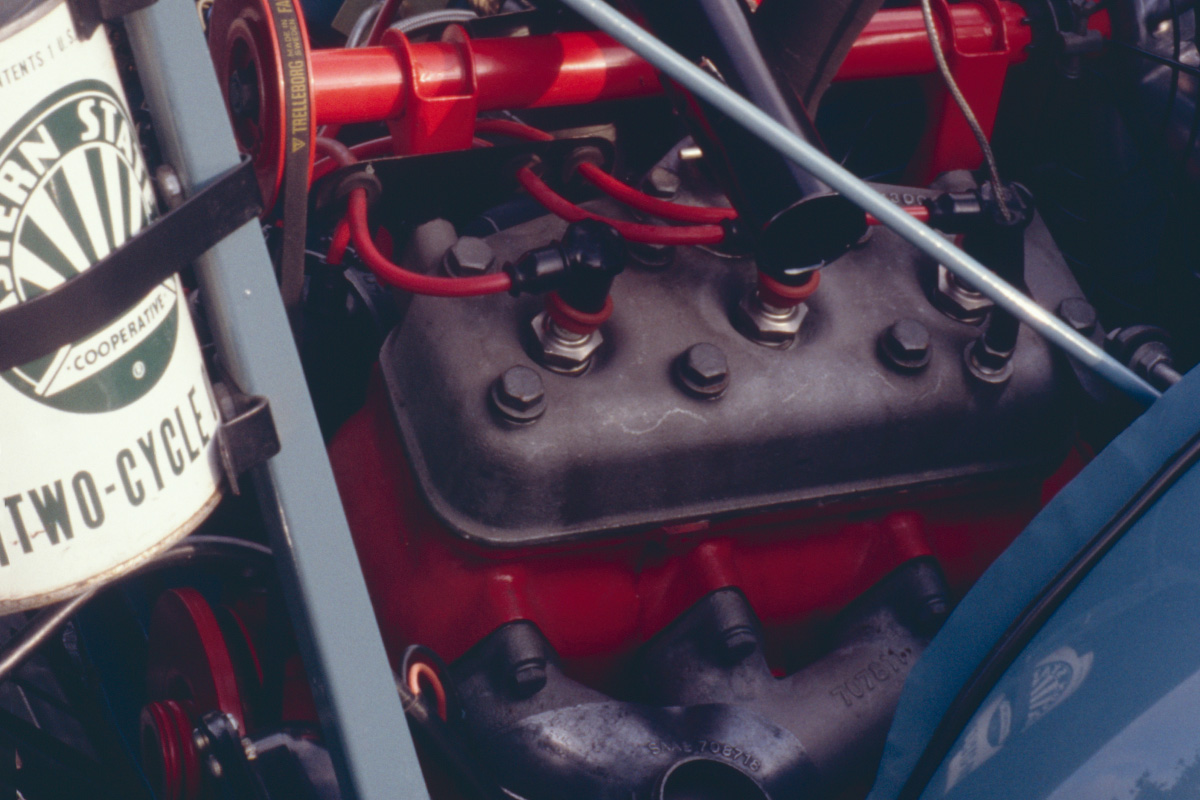
The engine was truly a two-stroke racer. Saab engineers used the standard 750cc block but raised the compression ratio from 7.3:1 to 9.0:1. New port timing was developed and forts were carefully opened up and matched. (Anyone with motocross experience will will understand). The crank pin balance holes were filled in to increase compression in the bottom end, reducing its volume increased the velocity of the transfer from the bottom of the engine to the combustion chambers. The modifications raised horsepower from 38 to 50 bhp SAE at 5000 rpm, an exceptionally large increase. A special tuning kit, comprised of a Solex dual carburetor and a new intake manifold, and an exhaust system that eliminated the rear muffler, raised output to 57 bhp, all for $148.
The engine, with a red coat of paint, was installed in what was a standard Saab 93 chassis. The standard three-speed transmission was used; gear ratios weren’t changed but the final drive was, from 5.43:1 to 4.85:1, for a higher top speed. There were no special springs or shocks, although Pirelli Cinturato tires replaced the standard Continentals and 9.0-in., drum brakes replaced the standard 8.0-in. units. The bigger drums would become standard on the 93B in the fall.
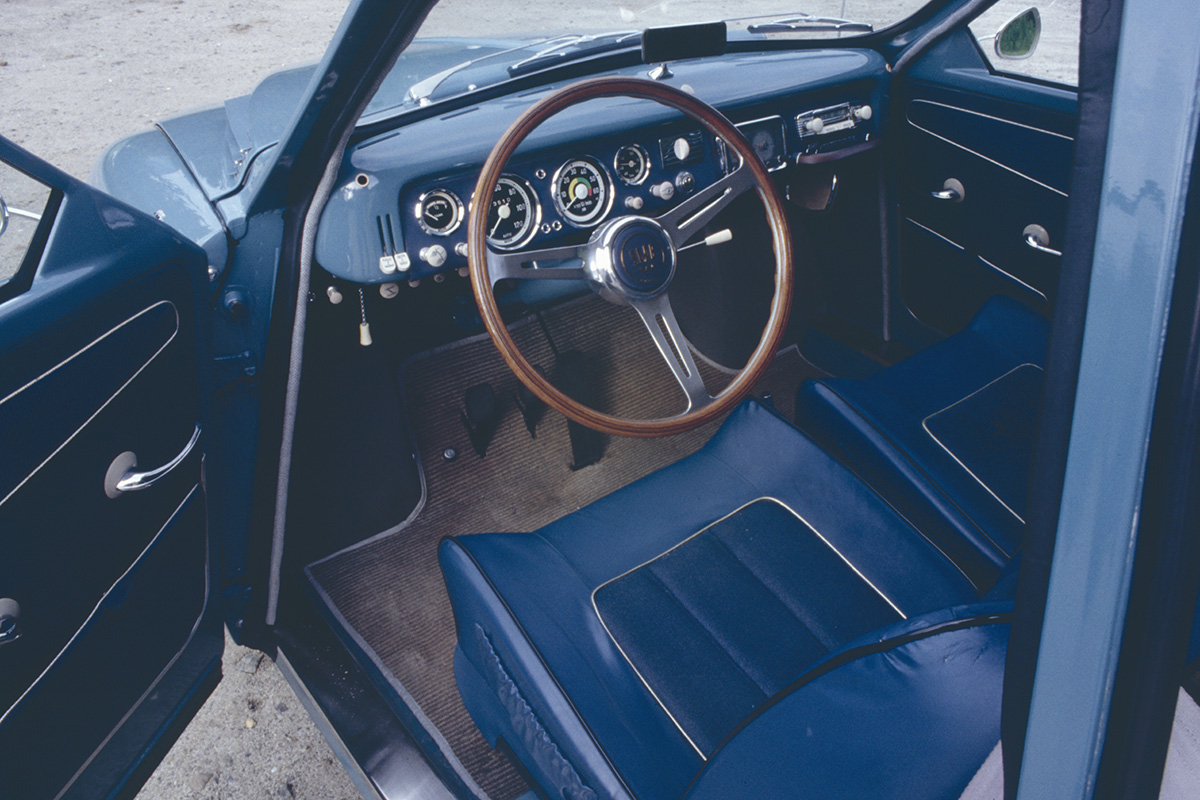
The interior received a lot of attention, with special adjustable bucket seats, fully reclining and fitted with a headrest on the passenger side. Both seats had a special backrest cushion that could be adjusted up or down. The instrument panel was revised, the standard horizontal band speedometer replaced by a large dollar and tachometer, both round and with the tach of marked with safe operation bands, yellow to 3000 rpm, green between 3000 and about 5800 rpm, and red above that. A Halda Speed Pilot, a mechanical rally computer, was mounted on the dash for those who competed in rallies or wanted to look like they did. The driver had a beautiful, is dangerous, wood-rimmed steering wheel while the passenger/navigator got a dash-mounted grab handle. Seatbelts were standard. The backseat, however, was then and mostly a cover for a compartment for rally equipment, although the rear passenger did get an armrest with a holder said to be perfect for Coca-Cola bottles!
The Saab Granturismo 750 listed $2,568, not particularly cheap for 1958, though as Road & Track asked, “Where else can you get a top rally car, a fine class-racing car and an able, fast touring car all rolled into one package for under $2800?” Indeed, said the scribes from Newport Beach, “this car is faster than several highly respected 1500- and 1600 cc machines and nearly as fast as one of the more popular 2.0-liter sports cars.”
Comparative times showed a stock 93B requiring 27.2 sec. for 0-60 mph and 23.0 sec. for the quarter mile. The GT, on the other hand, zipped through the 0-60 mph in 15.2 sec and the quarter-mile in 18.5 sec., while a tuned GT did 0-60 mph in 12.0 second and the quarter-mile in a mere 17.5 sec., a veritable flash.
The Saab GT750 lived up to expectations on the track, particularly at Lime Rock’s “Little Le Mans” and the enduros at Marlborough, often snatching class victories and placing well in the overall standings. But what is good for the track is often less than ideal for the road. Factory Saab technician and long ago GT-owner John Moss tells of having had three sets of spark plugs: a hot set for starting, colder plugs for running, and for high-speed use, a cherished set of platinum-tipped plugs. Fouled plugs were the bane of the two-stroke driver and even more so in the GT owner, but hot plugs, which resisted fouling, could quickly hole pistons.
Another problem was a lack of low-end torque. Although the standard 93 was weak at lower rpm, the Saab GT750 was virtually comatose. Moss claims that giving a GT full throttle at less than 3000 rpm will make the car slow down and die. Road & Track noted that to keep the GT on the pipe, it had to be revved to 5000 rpm before shifting or the tach would fall below 3000 rpm for the next gear. While this was fun on the highway, it made city driving a chore. In town, said the magazine, “it is difficult to keep the ribs and your enthusiasm up at the same time.”
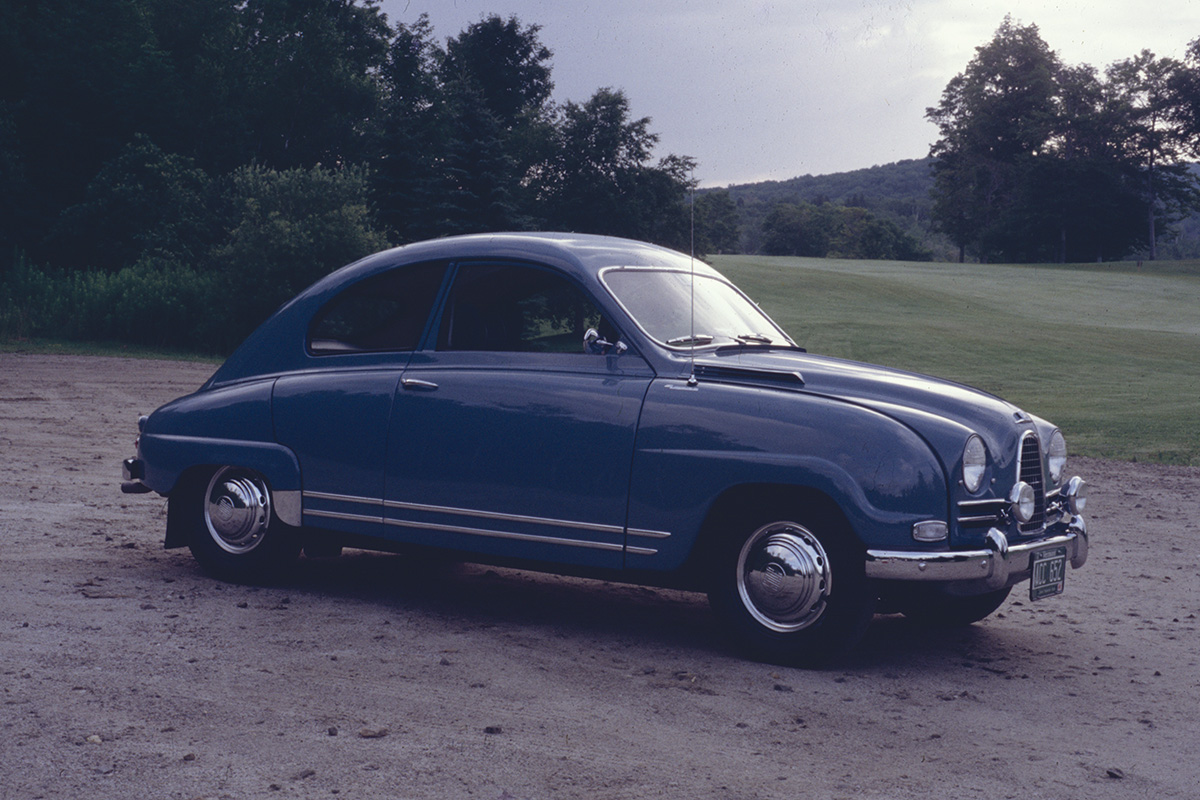
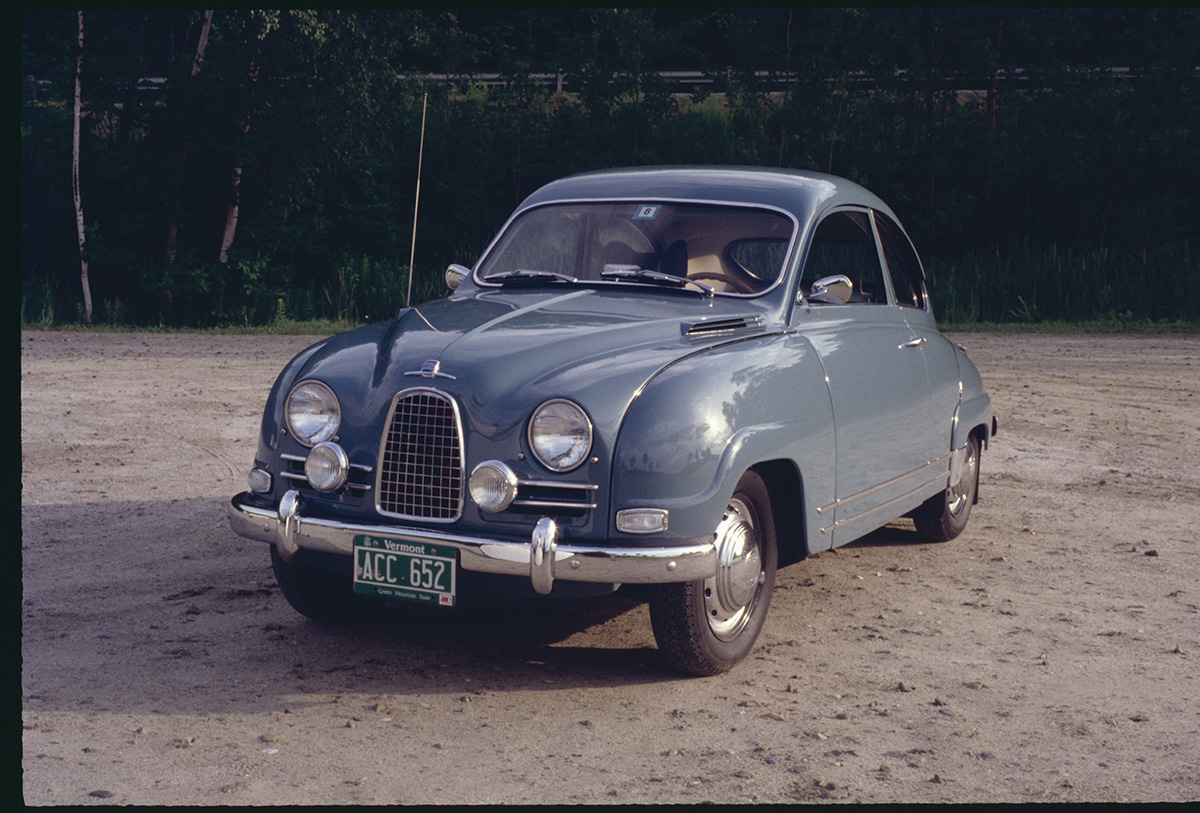
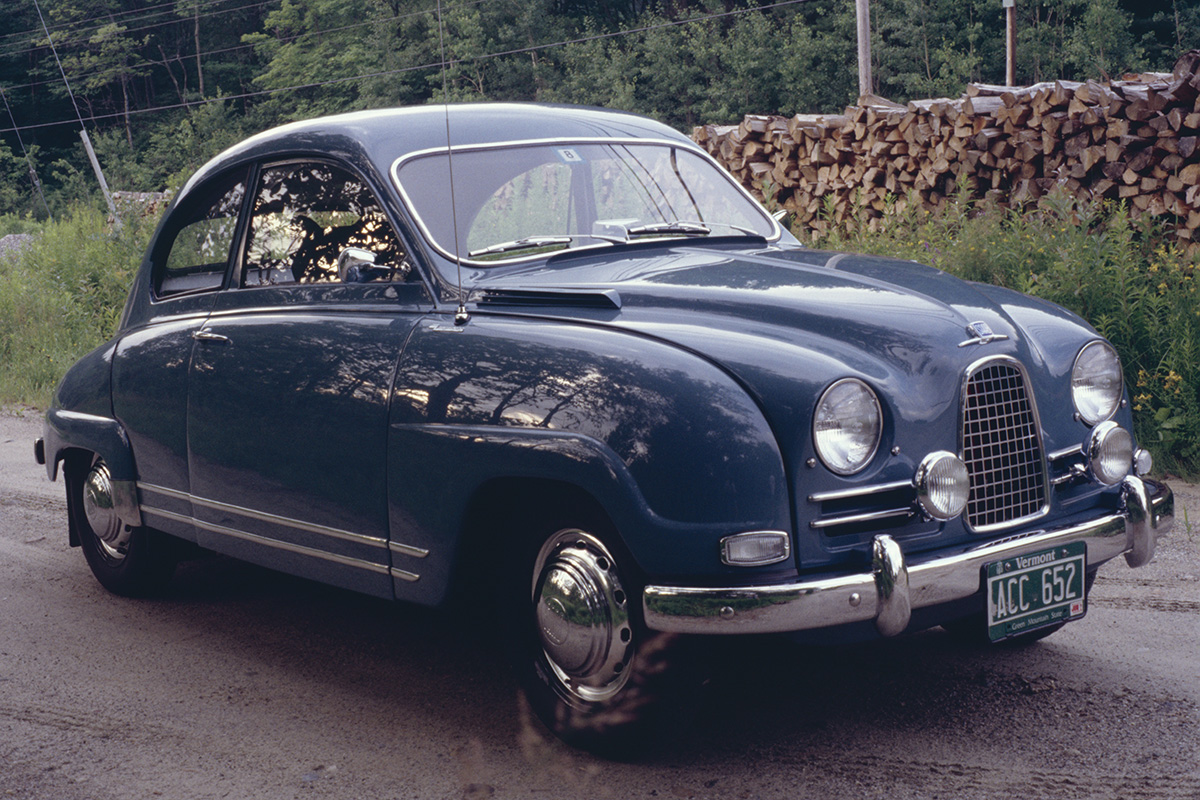
The owner of a fully restored, baby blue 1960 Granturismo 750 concurs, calling it a “rural car.” Bruce Welch, of Williamstown, Vermont, notes that different jets were available for city driving, although changing carburetor jets is even more inconvenient than replacing fouled spark plugs. The “city” kit for the single-throat carburetor reduced venturi size (from 31mm to 28mm) and included smaller jets, but it also carried the hazard of engine damage from the lean mixture if any hard-driving was done. The smaller jets also allowed less lubrication into the engine.
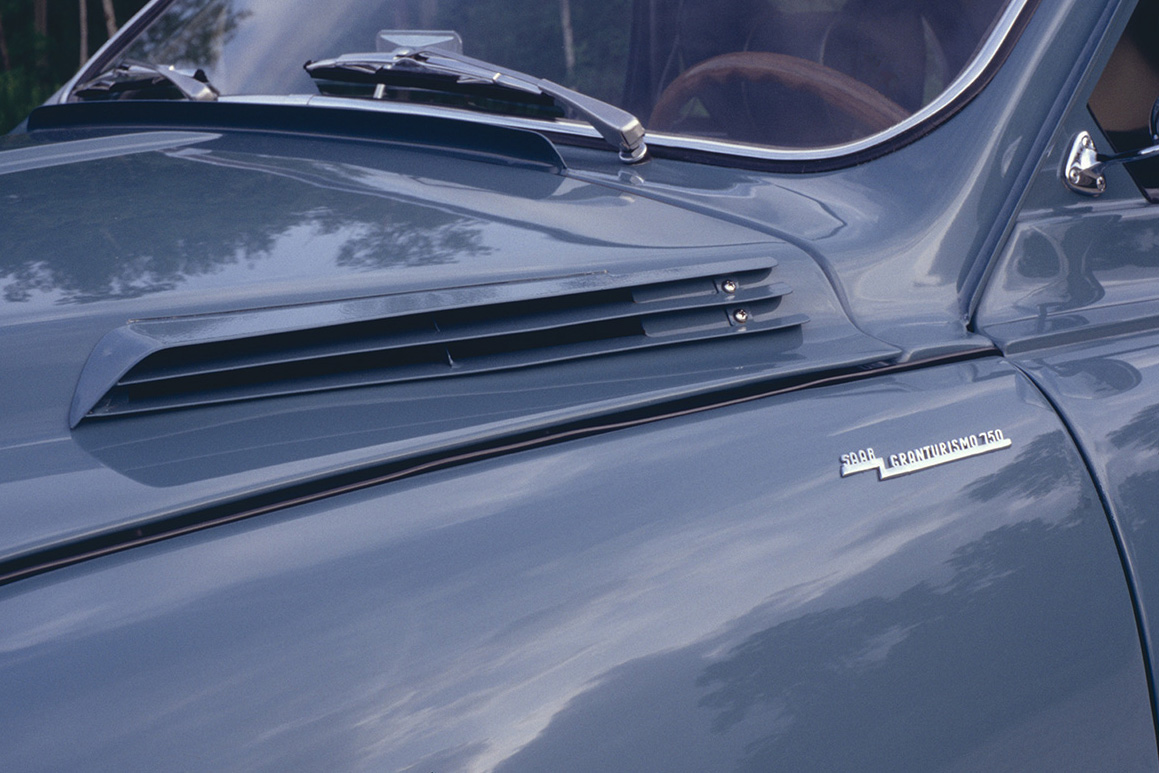
Welch’s car had another modification. The vents on the trailing edge of the hood are part of a “Southern climate” kit, allowing hot air to escape the engine compartment. Welch retrieved these from a used hood and installed them on his hood. The radiator, as on all 93s, is behind the engine. He adds that another part of the kit, an ancillary water radiator that mounts low at the front, that was available but is not on his car. The cooling on the Saab GT750 was marginal. It is not, he says, a good parade car.
Welch’s Saab GT750 is unusual in that it has the front hinged doors of the 93F, the transitional model between the 93B (with “suicide” doors) and the 96. European makers didn’t strictly follow model years at this time 93F appeared in late 1959 and continued until the 96 went into production in the spring of 1960, although Saab coyly avoided giving it a model year designation. The 96 had a larger 850 cc two-stroke triple, but the Saab Granturismo 750, though it had the new 96-style body and used the 96 is four-speed transmission, remain at 748 cc and deference to international racing class rules. A Granturismo 850 (called Saab Sport in Europe debuted at the Stockholm auto show in February 1962 and had a number of refinements. The Saab Granturismo 750, however, was the original – a fast, fun if fussy flyer.
Addendum: The Saab 93 could be modified for performance in other ways. When Saab wanted to compete in the 1500cc class, it combined two of the 750cc in-line three cylinders to create a car the Swedes called The Monster. It was fast but didn’t go around corners very well. Read about it here.
When the Saab 96 was powered by the Ford V-4, that opened up a whole new catalog of performance parts that were all available through the Saab performance department. Here‘s what can be done and yes, it’s fun to drive.
Or for more Saab articles, go here for the list.