In the ‘30s, Auto Union was a German General Motors, Sloanian to the max, a car for every pocketbook. DKW –Das Kliene Wunder (the small wonder) – staked out the lower price range and the mighty Horch rivaled Mercedes-Benz, with Audi just below. And between DKW and Audi lay Wanderer. These four companies formed Auto Union, thrown together in 1932 by hard times that interlinked its parts as tightly as suggested by its quasi-Olympic four-ring corporate symbol.
Wanderer was a high-quality, mid-range brand, as even DKW automobiles were aspirational in a country where most motorized vehicles with four wheels were beyond the reach of the common man.
History/driving impressions originally published in AutoWeek December 9, 2002; republished by author John Matras
Wanderer’s first models under the four rings had six-cylinder engines with parts gleaned from the common Auto Union parts been. The Porsche-designed engines had displacements of 1.7 liters and 2.0 liters in the W 20 and W 21 respectively. Like miniature Horches, Wanderers had rear-drive, unlike the front-drive Audis and DKW’s.
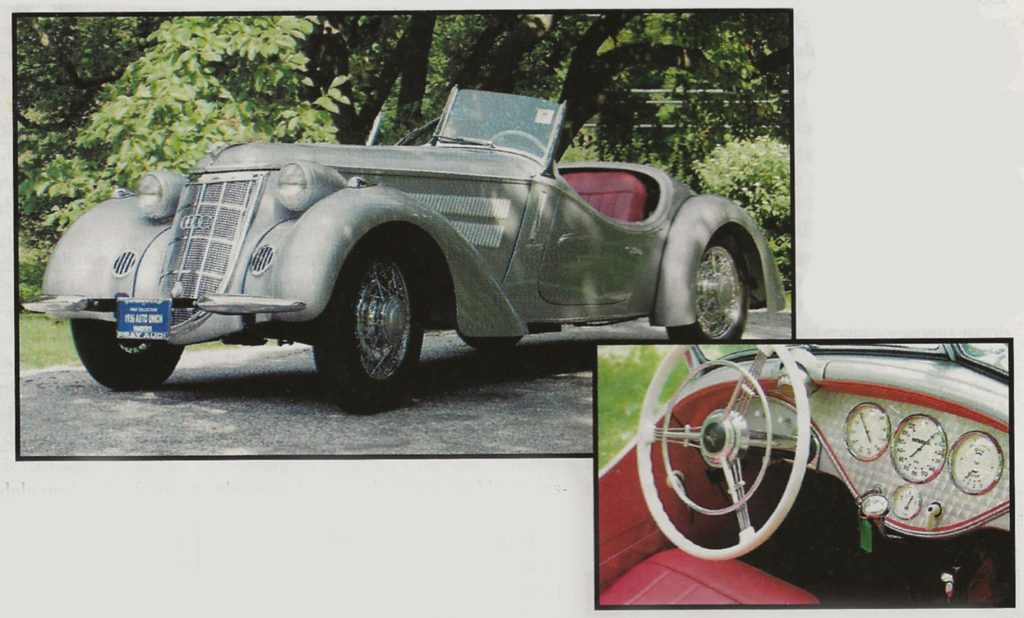
Inspired perhaps by the “fifth ring” of the Auto Union racers, huge Porsche-designed missiles with V16 engines amidships, Wanderer introduced a sports model in 1936. The two-seater, dubbed the WandererW25K, was offered as a two-door cabriolet and the two-door Wanderer W25K Roadster. The latter, about 150 pounds lighter, had a rounded shield-shaped grille, cut-down sides and a split windshield unframed along the top edge. The hood, impressively long for a car only 166 inches front to rear, covered a long-stroke six-cylinder engine that displaced 1962cc. The seven main bearing aluminum block had chrome-plated cast-iron cylinder liners and an aluminum head. A chain-driven camshaft in the side of the block opened two valves per cylinder via pushrods and rocker arms. Standard fitment included a Solex 32 FFUS carburetor and a Roots-type supercharger. The K in its name stood for “Kompressor.” So equipped, the six produced 85 horsepower.
The Wanderer W25K roadster and cabriolet had a box-section frame with a separate steel body with independent front suspension and a live axle at the rear, both ends supported by transverse semi-elliptic springs. Drum brakes were hydraulically actuated. Relatively sleek, the W25K had a top speed of about 90 mph. Thrilling stuff indeed on the Reich’s new autobahns, but as a competition model to challenge the contemporary BMW 328, it fell short. Its four-speed transmission, fully non-synchro, was notoriously fragile as well. Looks alone were insufficient to save the day.
Only 149 Wanderer W25Ks were built in 1936. Sales slid to 72 the following year, and in 1938, a mere 37 were sold.
As a limited-production sports model, Wanderer W25K roadster and cabriolet was hand-made and hand-assembled, and there are differences from car to car. At least one car, now owned by Malcolm Pray of Greenwich, Connecticut, seems to have been built without the supercharger, mounted with a pair of carburetors instead. There’s also an apparently legitimate number plate that indicates this Wanderer was built in 1949. Since it’s doubtful anyone would fabricate a phony Wanderer – especially with a number plate outside the years of production when there are more lucrative suspects to phony up – this particular Wanderer may be one that was built from leftover parts that survived the war, a way to generate Deutschmarks in postwar Germany.
The Wanderer, however, has the same “flying W” hood ornament that dates back to the bicycles built in the 1880s gracing the front of the louvered hood. The doors open from the front and one sits low on flat-cushioned seats. An engine-turned dash lies behind a characteristically German white-rimmed steering wheel with a “flying W” in the hub. A tachometer is calibrated to 4500 rpm – max power comes at 4000 rpm – alongside a 120-km/h speedometer. Oil pressure and fuel gauges are off to the right. A dogleg shift lever reaches from under the dash. The throttle pedal is a chrome spoon, with rubber locks for brake and clutch.
Performance of the Wanderer W25 – especially without the K – is modest by modern standards, and the nonsynchro transmission is a challenge for anyone not accustomed to matching revs, especially with a delicate gearbox. Even mit kompressor, the W25K would not match the BMW 328. Although DKW endured into the ‘60s and the rings of Auto Union live on with Audi today, Horch and Wanderer didn’t survive World War II. More’s the pity, because the Wanderer is too handsome to be so frail.
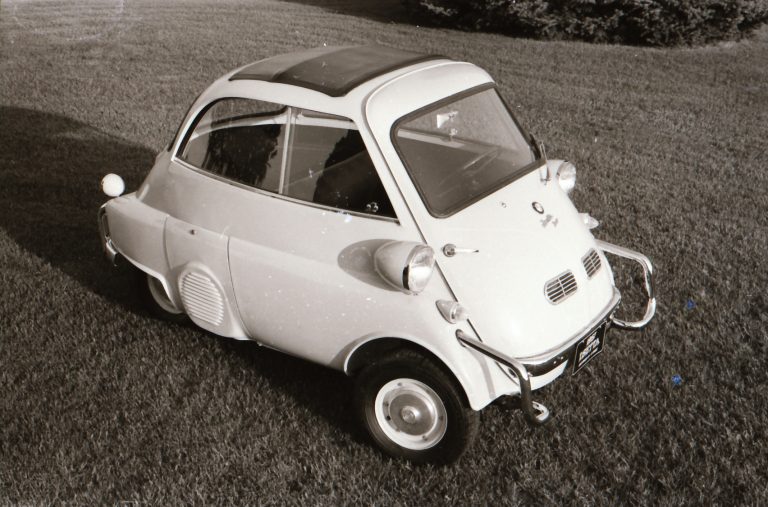
Addendum: Mercedes-Benz was a survived the war and would begin working its way up to profitability with the Mercedes-Benz 170S and in a very few years was racing as almost nothing had happened, fielding the Mercedes-Benz 300SL in 1954. BMW had more of a struggle, almost bankrupted by the BMW 501 and BMW 502. The BMW 507 was beautiful but not a financial success, BMW relying on the tiny BMW Isetta to tide the company into profitability.
Over a quarter-century, I managed to misplace my original transparencies for this article so I lifted my photos from the original magazine posting.