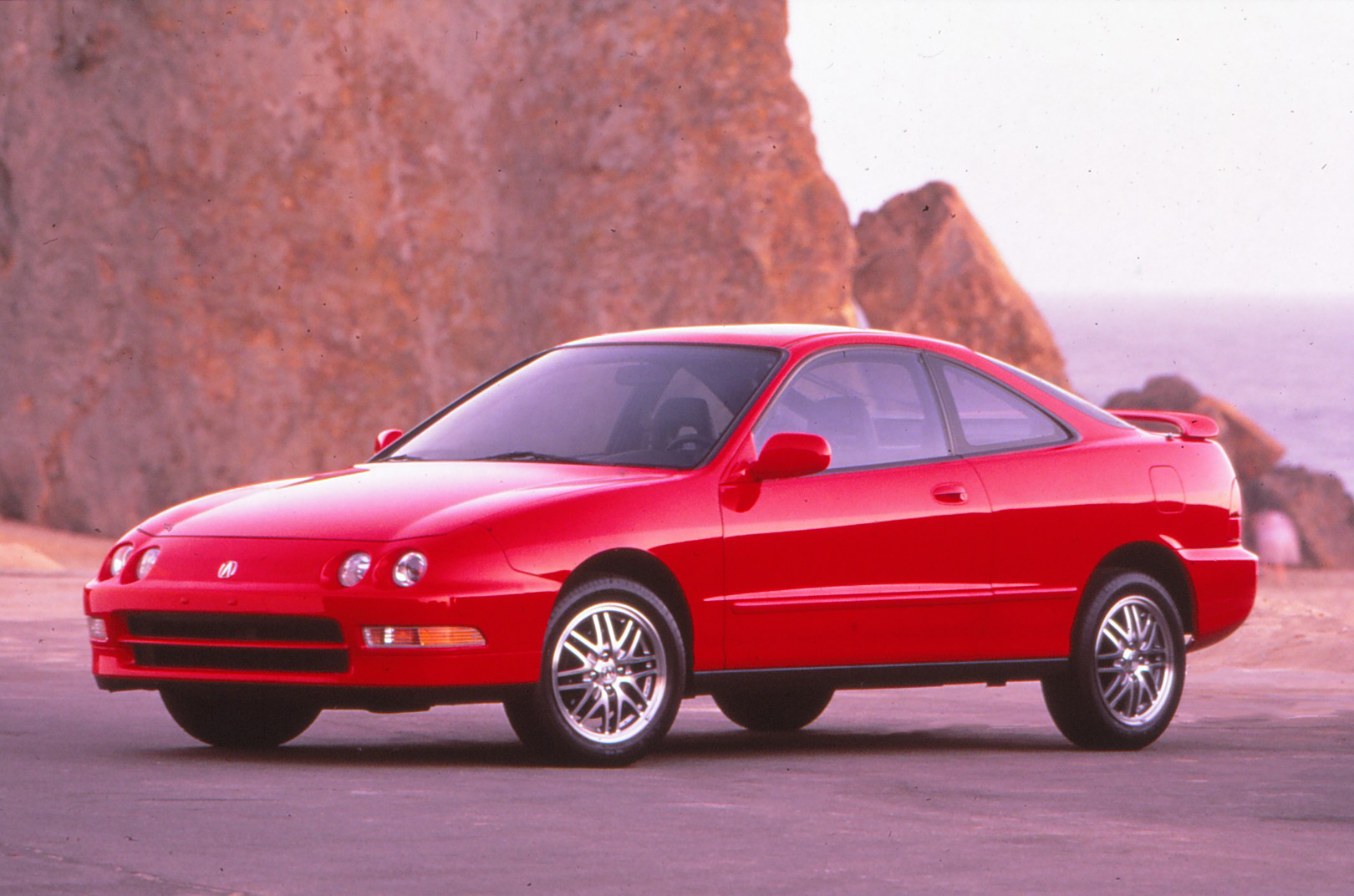
1997 Acura Integra GS-R Coupe


You could, like 1996 Indy Car champion Jimmy Vassar or rookie of the year Alex Zanardi, drive a Honda HRH V-8 Indy Car. Then you’d have a high-revving, high-performance engine and view of the road that starts not far beyond your toes. You could, but then you wouldn’t have a backseat, or any passenger seat at all for that matter. There’s no standard moonroof (there’s no roof at all!). And even if you can outrun the cops, the DMV will get you at the next annual vehicle equipment check. Headlight aim? What headlights?
Here’s a better choice: the Acura Integra GS-R. Admittedly you’re giving up some 600 bhp, but consider that both vehicles come from the same parent company, the GS-R has advanced VTEC engine technology and you can get snow tires in sizes to fit the Integra.
Contemporary review originally published in Road & Track Sports & GT Cars 1997; republished by author John Matras
The Integra cost a lot less, too. The Integra is the entry-level model for Honda’s upscale Acura line (also the only model that still has a name, rather than an alphanumeric designation). It is available in coupe or four-door sedan versions and in assorted trim levels, from base RS powered by a 140-bhp dohc for to the 170-bhp GS-R. The top-of-the-line GS-R list for a mere $21,100, a bargain for this container of densely packed functional technology.
That technology will undergo more advancement later in 1997 when the Integra Type R is introduced. Sort of a production racer for the street, the Type R will be powered by a 1.8 liter VETC four-cylinder that will put 195 bhp to the front wheels. Positioned above the current GS-R, the Type R will feature a beefier suspension with increased spring rates, stiffer bushings, thicker anti-roll bars and larger tires. No price has been set, but it will be more expensive than the current GS-R and only 500 or so units will be for sale this year. Expect the Type R to be a decontented Integra with no moonroof or a/c, sporting a huge hoop-type rear wing to set it apart from the other models.
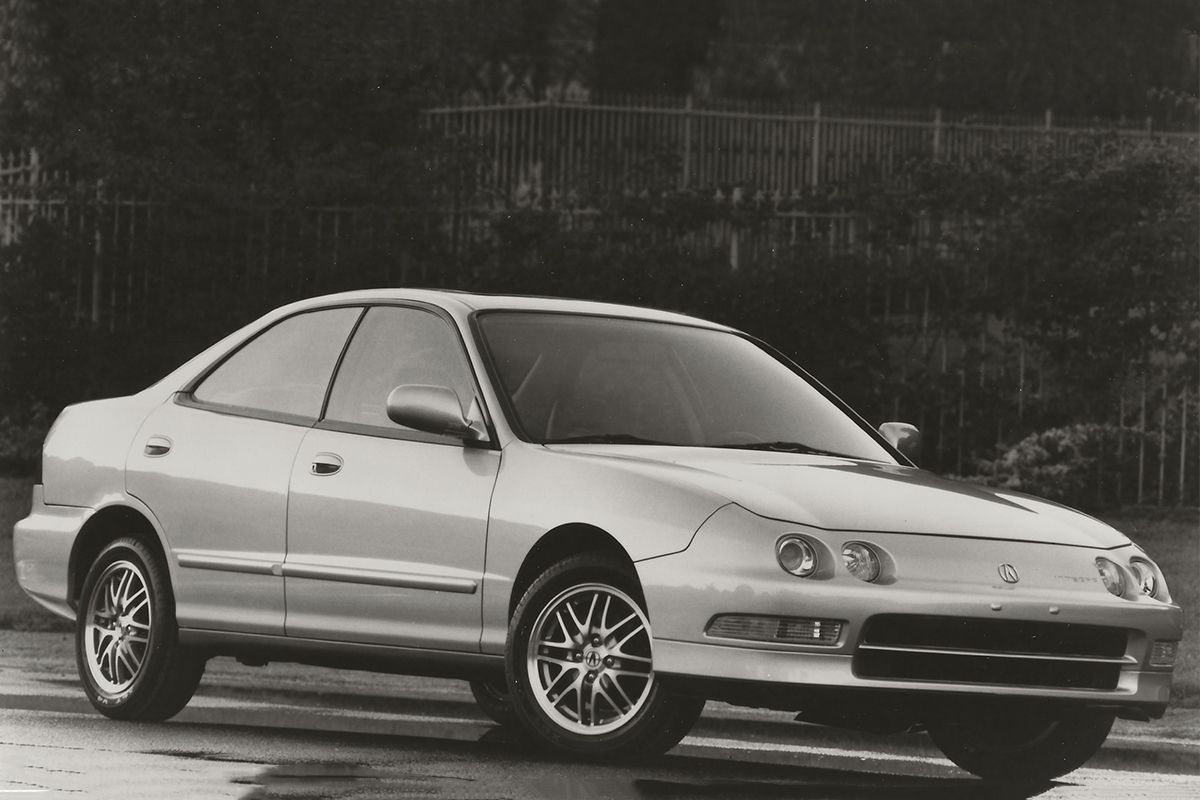
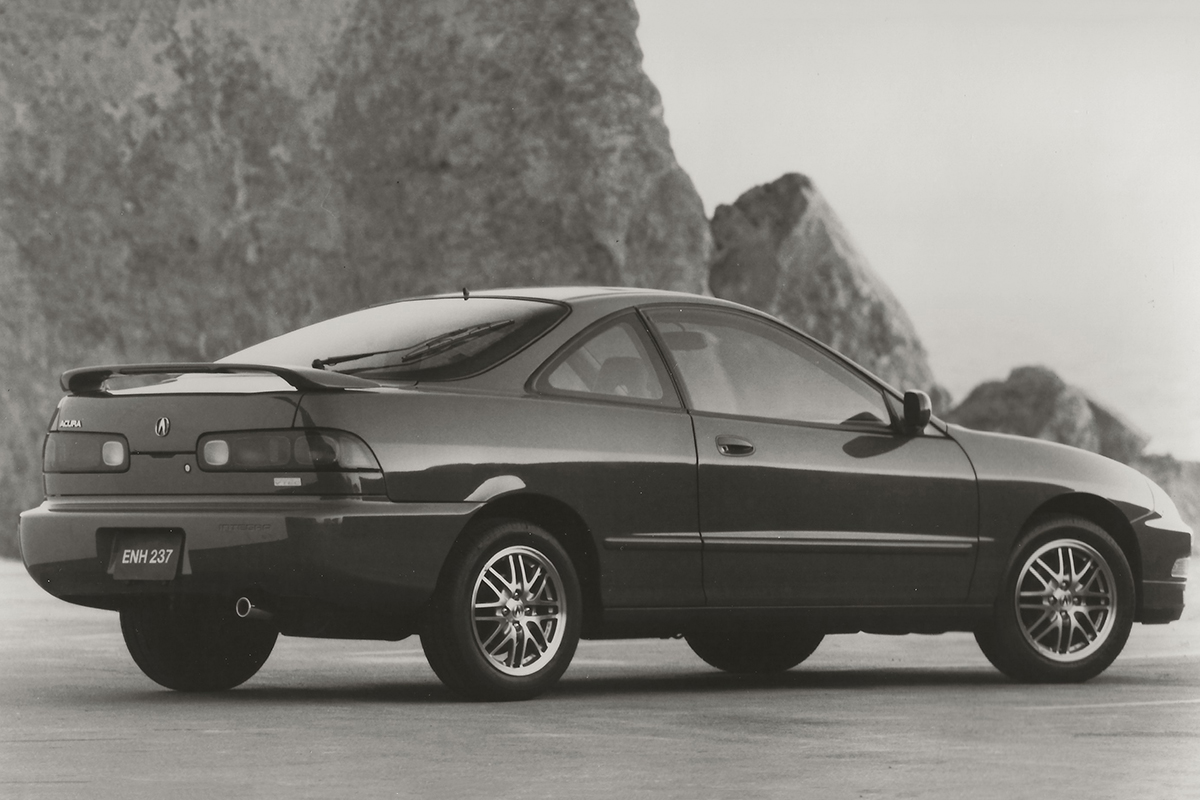
The GS-R Coupe rides on a 101.2-inch wheelbase, almost 2 inches shorter than the sedan’s, but still several inches longer than many competitors. It’s a trim 172.4 inches long, dimensions tight around the car’s mechanicals, and the coupe stands out not only from its sport-coupe rivals but from the Acura line in general. Without a doubt, it’s the sportiest of any Acura this side of the NSX, most of which are generally biased toward the lecture side of autodom. The Integra coupe, with its distinctive wedgey profile and petite dimensions, is definitely the sportsmeister.
Enhancing that impression are the four marble-lensed projector-beam headlamps frenced into the front end, giving the Integra the passively amoral visage of a spider. The headlamps are actually set into the bumper, an outsized one-piece assembly that not only gives the Integra a clean and nasty frontal aspect but also aids aerodynamics by minimizing the seams and other laminar-flow-disturbing features. The beltline rises toward the rear and the decklid is topped off by wing that probably has some effect in high speeds but otherwise mostly interferes with vision to the rear. Not too bad for driving, but backing up an Integra is almost as difficult as with a van. Despite its semi-notch styling, however, the coupe is a hatchback, rare these days but useful for moving televisions and such, especially if your personal fleet isn’t large enough to include a truck.
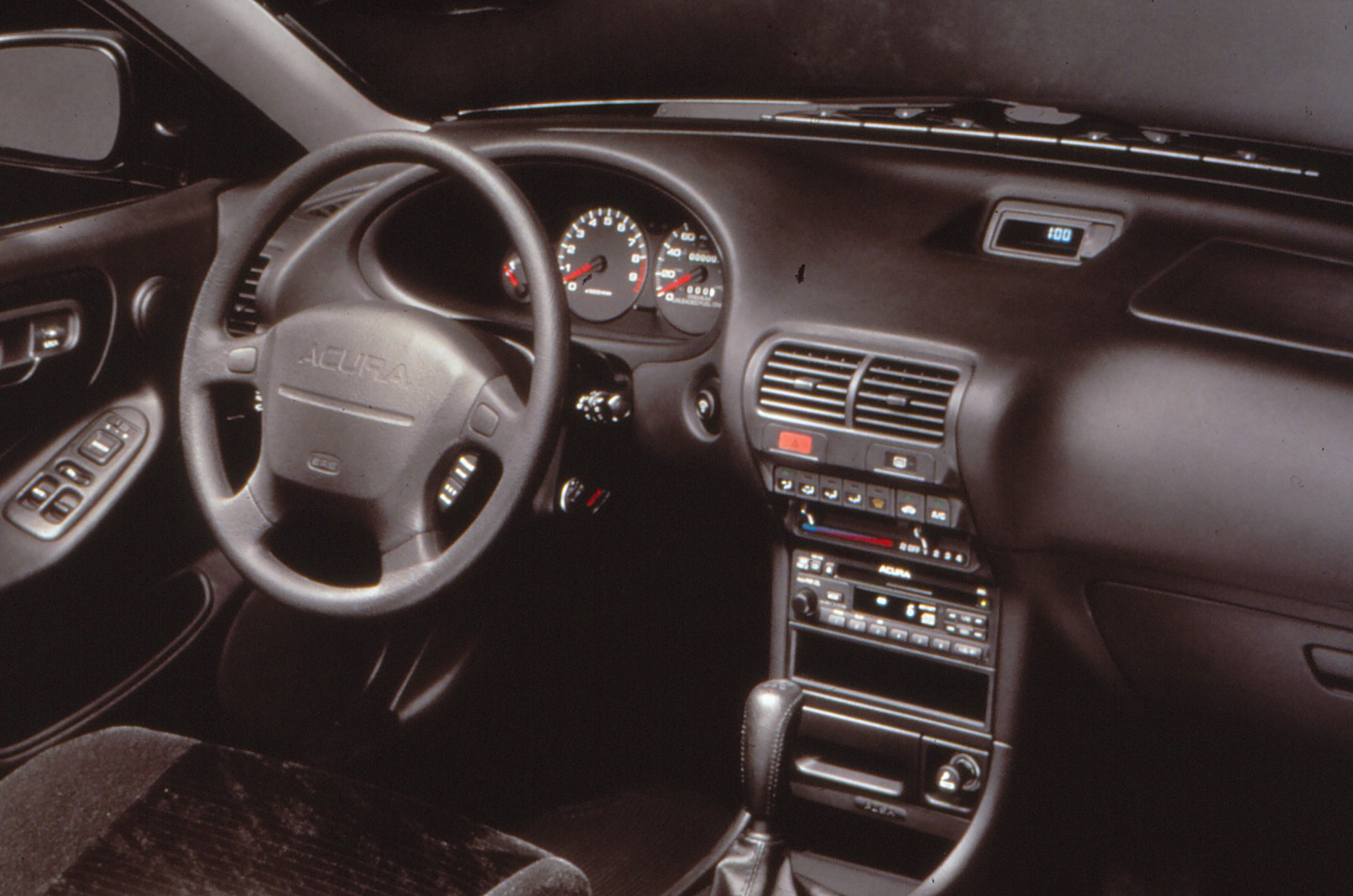
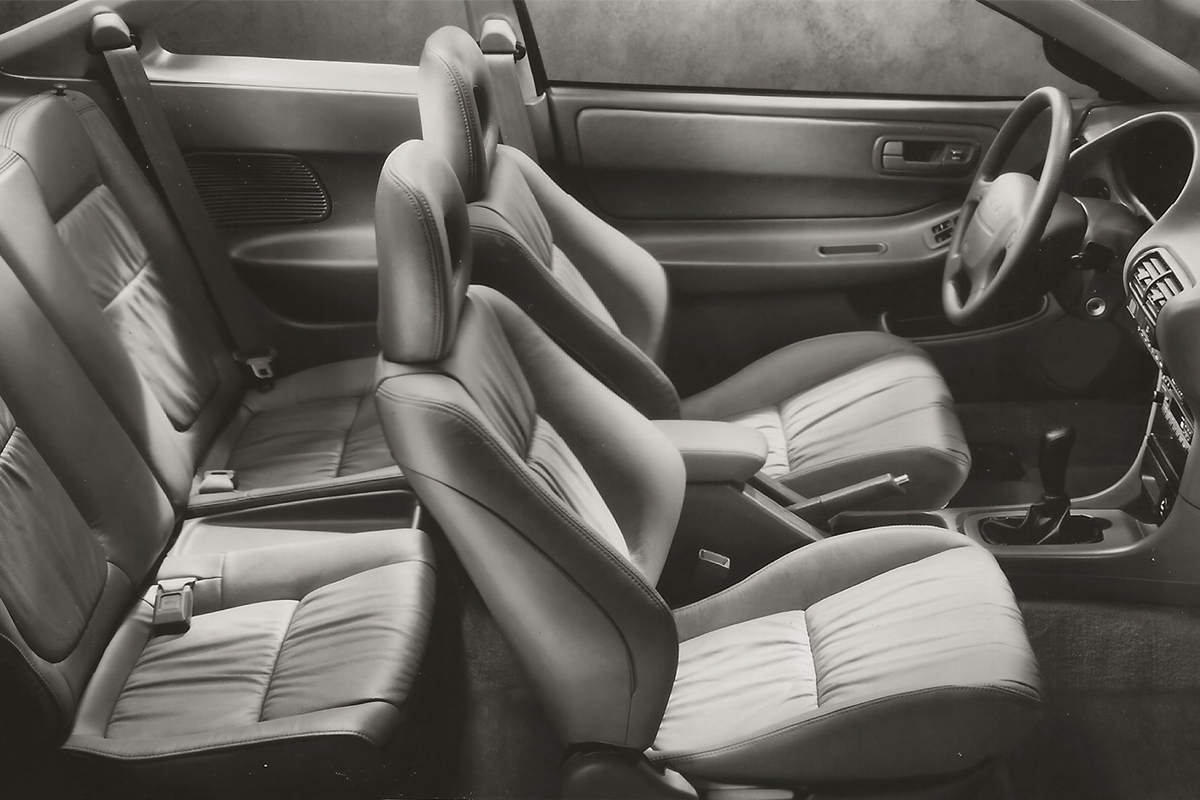
The windshield, if it came from GM, would be named Vistamax or something similarly silly, as it provides a superb view of the road ahead, thanks to slim A-pillars and the low cowl that has become an art form with Honda/Acura cars. You can see payment just ahead of the front bumper, and although that’s not where one should be looking when driving at speed, the panorama is delightful. The interior, however, is entirely without guile. Don’t look for exotic features such as a head up display or an electronic parking-brake lever warmer. Instead look for a solid execution putting things where they belong. The HVAC controls are a little out of fashion, with slide heat and fan-speed levers, and the cupholder pops out of the dash to block the cigarette lighter – this in a car that inspires radar detector use. This speedometer and tach are large, however, and along with fuel and coolant temperature gauges, fit in neatly contoured pod.
Front-seat occupants reside in buckets that are well bolstered for hard cornering and better fitted for the narrow of beam, the grippy cloth upholstery adding to their horizontal hold. The rear seats are difficult to enter (big surprise in a coupe). Once ensconced therein, passengers will find impressive legroom for this class of car, but anyone over about 5-ft 8-in will be head banging on the backlight glass.
An electronically controlled four-speed automatic (with grade logic control) is optional, but enthusiasts will prefer the 5-speed manual. Prefer? They’ll benchmark it for other front-drive cars. The linkage is rigid and precise, with short throws fore and aft in a pattern so narrow that Integra neophytes will miss shifts by either tripping on the gates or going a gear too far over. Be careful shifting down, y’hear?
With the GS-R, however, upshifts needn’t come till the tachometer points to 8000 rpm. The Integra’s dohc 16-valve four utilizes the same VTEC technology as Acura’s NSX and make it feel much bigger than the 1.8 liters it really is. VTEC, working on intake and exhaust valves, has three cam lobes and three rocker arms for each pair of valves. The outer two lobes have lower lift and low overlap profiles for low-speed torque and response, while the middle lobe has higher lift and longer duration for better breathing at high rpm. Below 4400 rpm the two outer rocker arms control valve actuation, but above that the middle rocker is locked onto the outer two by computer-controlled hydraulic piston and the valves are actuated in accordance to the more radical middle cam. Combine that with a dual-stage intake manifold with two unequal-length intake runners for each cylinder and it yields a relatively flat torque curve for the GS-R. A butterfly valve blocks the shorter path until 5800 rpm, providing additional airflow and different intake tuning, maximizing torque on both sides of the switchpoint. The GS-R’s maximum 128 lb-ft of torque is at a lofty 6200 rpm, but it hovers near 120 lb-ft all the way down from 3000 to 7000 rpm.
Horsepower doesn’t peak until 7600 rpm and the engine sings all the way there and beyond, right to the 8000-rpm redline. If that’s 2000 rpm or so beyond what you’re used to, so be it. One could drive the GS-R never venturing above 5000 rpm and be happy. Most around-town driving would be well served by the lesser and less expensive Integras. But ecstasy comes from revving the VTEC’s four at every possible opportunity.
That said, the Acura Integra GS-R is still no dragster. Straight-line performance will be better served elsewhere. The GS-R’s forte is winding roads, the twistier the better, particularly if some off-camber and drop-away corners are thrown in to keep the Integra’s suspension honest. Well, Mr. Washington, the GS-R chopped down your cherry tree. The Integra’s suspension seems devoid of bump steer and has better damping than a featherbed. And unless the pavement is particularly slippery, the Integra does a wonderful job at concealing which tires put the power to the ground.
Front and rear there is a race-car-like double-wishbone suspension, although Acura gave the front suspension a new angle with an L-shaped lower control arm. Bushings in the lower arm are tuned to allow toe-out while breaking, which aids stability, particularly in a corner. So does negative-scrub geometry which also eliminates steering wheel kickback when, for example a puddle is hit at speed. On the GS-R, the anti-rollbar connects to the control arms with ball joints rather than bushings for more precise control and upper and lower inns of the shock towers are linked across the engine bay for more exact location of the suspension points
All Integras have disc brakes at all four wheels, with ventilated discs up front and solids at the rear. Front calipers are larger and stronger than usual to resist flexing and spread under hard breaking. It’s what one doesn’t feel that’s good here. Braking is steady and progressive. ABS is standard.
The Acura Integra GS-R is not Jimmy Vassar’s racer, a car good enough for the 1996 PPG Indy Car World Series Manufacturers Championship. But consider that this-generation Integra debuted in 1994, the same year Honda first went anti-car racing. Coincidence? You be the judge, but only after spinning that four to 8000 rpm several times, taking a corner or two and braking for a third. Maybe something is there after all and remember this: Commuting to work in the Integra GS-R means you won’t have helmet hair all day.
Addendum: Check another Acura without a back seat, the Acura NSX, in another contemporary review in Remember Road.
Don’t confuse the Acura Integra GS-R with the Integra Type R. While the GS-R in good condition will sell in the $12,000 range, the Type R in equivalent condition, according to Hagerty, will bring over $40,000. Supply and demand strikes again.
Photos with the original published article were by Guy Spangerberg.
Click for all Acura articles on Remember Road.