Jack Griffith could have kept the dealership. Griffith was doing quite well enough, thank you, in Hicksville, New York, out on Long Island. Not only was Griffith selling Fords and Cobras, but he was picking up Cobra bodies at the port and holding them until Shelby’s transporters arrived to take them west. A young engineer named Mark Donahue drove in one with Griffith’s Cobra, one of two factory prepared racers, he says, in the East. Bob Johnson in Ohio had the other. Then one day Dick Monnich dropped in.
“Dick Monnich, who lived in that same town, was importing TVR’s on a very limited scale [and] came by to see me one day. We got to talking about it and we decided to play around and put a 289 in his TVR.”
History and driving impressions originally published in Special Interest Autos, December 1991; republished by author John Matras
Well, TVR was and still is a small British sports car, but even smaller then than now. Monnich’s car, a Grantura Mark III to be exact, was mostly a collection of tubes covered with a stubby fiberglass body, just as it had come from the TVR works at the Hoo Hill Industrial Estate near Blackpool, England. The main chassis structure was four longitudinal tubes, cross brace for strength, forming a backbone. Double A-arm independent suspension in front and rear with coil springs and tube shocks was easy to make and effective and much better than the suspension of earlier TVRs, which, front and rear, was derived from trailing arm front suspension of the VW Beetle. The standard engine was the four-cylinder MG MGA 1600 Mk II which, considering a curb weight of 1,625 pounds on an 85.5-inch wheelbase, was perfectly adequate for sporting performance. The 86-bhp engine yielded 18-second quarter miles and 0– 60 mph times in the 10 second range.
Not surprisingly, the Ford V-8 and the flyweight wrapping was substantially faster than the MG in-line four. A Cobra with the same engine weighed 500 to 600 pounds more and had almost a foot more wheelbase (though was three inches narrower), and on a good day a Cobra 289 could turn sub-14-second quarter-miles. The TVR with the V-8 should have required FAA clearance to open its throttle plates.
“It went so well,” Griffith says in monumental understatement. “I took it out to Ford and showed the people out there. They liked it and got behind the program with me and that’s how it started.”
Indeed those were simpler times. Griffith had hoped to produce what Road & Track called a “Falcon-with-a-Cobra,” a Ford Falcon with a modified 289 “Fairlane V-8” along with disc brakes. Monnich, already an employee of Griffith, had taken the TVR along as well. It is not surprising that Ford was little interested in the Falcon project, what with the Mustang project well along the way and Holman & Moody prepping Falcons for the Monte Carlo Rally. But of course Ford was perfectly willing to sell Jack Griffith all the engines he wanted. So with a source of engine secured, it was then a matter of getting the chassis.
“[Monnich] put us in touch with the right people in England,” Griffith recalls. “We flew over there and met with them and they decided they would do the project. We sent them some engines and they made the necessary changes in the chassis and so forth to accept the engine and hook up the drivelines. They started building them and shipping them over. They they’d ship us a car almost complete – minus engine and transmission, which we’d install at our place in Long Island.” The new facilities of Griffith Motors, Inc., were in Syosset, New York. Engines and transmissions came directly from Ford.
“We signed a contract for all their chassis output,” Monnich told Road & Track in early 1964. The first two were completed and shipped to New York for the International Automobile Show in April 1964. Only one car was shown, however. Longshoremen dropped a packing case on the other.
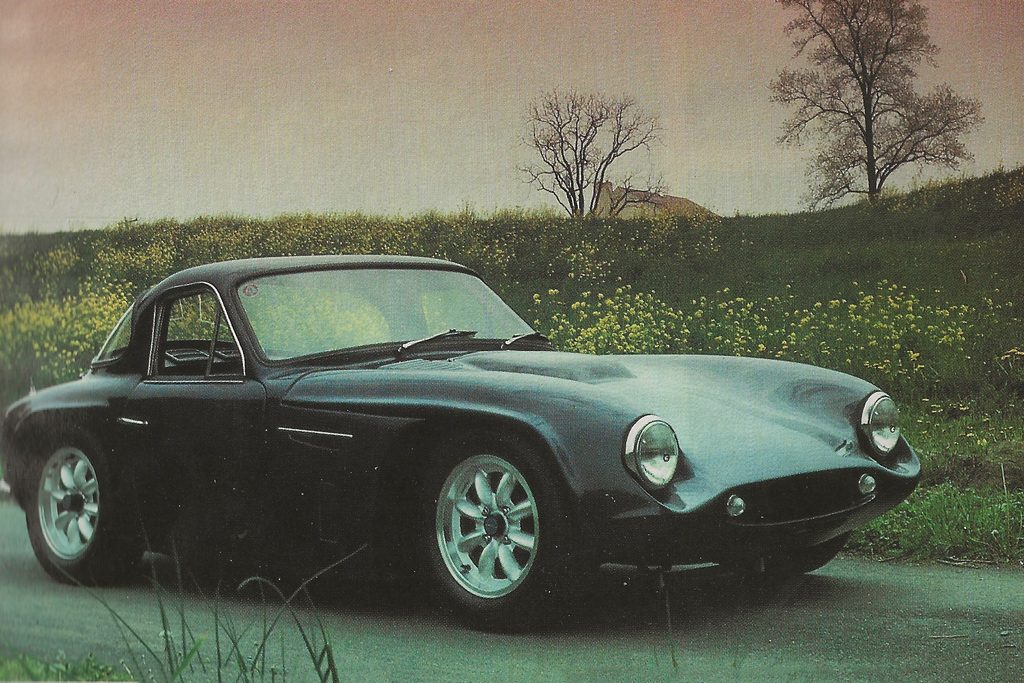
The car was called the Griffith 200 and differed little from the TVR from which it was derived. In fact, other than the big bulge on the bonnet to clear the air cleaner and larger dual exhaust, there were no external indications that the car had anything but the MG engine. Styling was in no sense beautiful, simply a way to cover all the mechanical bits with a relatively smooth shape with no unnecessary extras. Engine hood and front fenders were a single piece that tilted forward for access to the engine and suspension.
There was no opening in the cars rounded rump; any luggage had to be wrestled in past the seatbacks – and the spare tire out the same way. Rear fenders ended in finlets with small button-style Lucas tail and brakelamps. The small, slit-like grill opening, however, probably should have been changed as it made the Griffith susceptible to overheating until the factory began fitting twin electrical radiator fans on Jack Griffith’s suggestion. Both ends had bumperettes that were more styling concession than anything else.
The interior was also unchanged, except for what was necessary to fit the V-8 and its Ford transmission. Most obvious is the Ford “T-handle” four-speed shifter as in the 289 Cobra and Sunbeam Tiger rising from the wide center console. A tachometer and speedometer dominate the view through the de rigueur wood-rimmed “sports” steering wheel, while four accessory gauges and the assorted switches reside on the center dash. Below that is the heater. An open glovebox takes up the passenger side of the dash.
As with many other large engine/small body cars, heat in the cockpit was a major problem, despite standard rolldown windows. There was no air conditioning, of course, and the later addition of flip-out vents for the footwells was a partial solution best. Later cars also got engine vents in the fender side a la Corvette.
The chassis of the V-8 cars was very similar to those with MG engines and when modified proved strong enough to handle the additional torque, though the front suspension mounts were strengthened, as were the front cross tubes. The tubes around the engine bay had to be moved nine inches further apart to accommodate the engine, the front cross tubes moved forward to clear the Ford oil pan, and the passenger side frame tube “dented” in for about six inches to clear the starter.
A shortened Ford driveshaft and yokes were used, and on the series 200, the MGB “pumpkin” differential employed, although with halfshafts for the independent suspension. Surprisingly, these held up under the added torque if they weren’t abused – although that must have been more than a temptation and a source, deserved or otherwise, of the Griffith’s reputation for driveline fragility. According to Griffith car export Steve Ferrin, ring gears and the short inboard halfshafts had a tendency to go away. The Salisbury differential, as used in the Cobra, became standard equipment in the 400, though Griffith says now that was because they wanted to and not because of failures. The only ratio available in the MGB differential was 3.90:1, the Salisbury normally geared at 3.07:1. An extra spring-damper unit was installed on the Griffith’s rear suspension.
The standard engine for the Griffiths 200 was the familiar two-barrel, 289 cubic inch V-8 rated at 200 bhp, as was the solid-lifter 271-bhp, high-performance engine, both in standard Ford trim. Also, every Griffith 200 (and later 400) came with the four-speed. Griffith remembers displaying one car at the New York show with what was said to be a three-speed manual (but was really a four-speed) and disk instead of wire wheels to test the market for a cheaper model. “Nobody looked at it,” he says.
Though all cars were built on orders from dealers (no retail sales from the factory, Griffith insist), no “special equipment” versions were made at the factory. Of course, one could dip into Ford’s marvelous performance catalogs for those cams and carbs and manifolds and….
In 1964 the Griffith was restyled, virtually all of the changes coming from the rear wheels back, and renamed the 400. Out was the surrounded rear, and what was a “Kamm”-profile rear, bob-tailed with a ducktail spoiler and big, round tail lamps from the Cortina. (Actually, the Kamm profile, named after the aerodynamicist who discovered the drag-reducing shape, requires a much more gentle slope than the still steep rear window of the new design. Nevertheless, the 400 was markedly better looking for the change). Production of the Griffith 200 stopped at 203, and 68 of the 400 were made, 58 by Griffith in the United States, and 10 more by TVR after a reorganization, more about which later.
Griffiths Motors, Inc., advertised its fiberglass flyer with a Griffin-shielded knight and “You dreamed it… We built it… The GRIFFITH powered by Ford… 0-60 in 3.8 seconds… 145+ m. p.h. top speed… Easy-to-maintain, 289-cubic-inch Ford V-8 engine… Completely equipped at $3,995. Don’t just watch it go… Drive it!” (Ellipses in original.) Another ad showed the same knight and “Now you see it… Now you don’t. The GRIFFITH 200 powered by Ford. 289 cubic inch, 195 hp Ford production engine makes this 1,450 pound baby go, go, go! Independent all-round coil and wishbone suspension makes it ride, ride, ride! Dramatic decision makes it something to see, see, see!”
Not award-winning copy-writing perhaps, but enough to get the message across. Anyone with even a vague understanding of “power-to-weight ratio” knew this was the proverbial scalded cat, bat-out-of-hell performer. The engine was set well back in the chassis, and weight distribution was typically a 52-48 front and rear, per actual weighings by Steve Ferron. The only problem was the extremely short wheelbase. According to Rich Taylor in his tome Modern Classics, the “Griffith 200 pretty much pivoted on the front wheels to go around corners, with the significant weight of the rear just short of fluttering out behind.” Taylor was severe in his criticism: “I’ve driven a Griffith once, and vowed never to set foot in one again…. If there was ever a killer car, this is it. Flimsy, overpowered, really vicious handling that will spin you out just accelerating away from the curb… There has never been a more dangerous production vehicle. For $4500, Jack Griffith was doing a land-office business in rolling death traps and it’s a lucky thing for him that Ralph Nader wasn’t on the scene yet or he’d still be peeking out ‘twixt iron bars. If you ever need an expert witness, you quote me.”
Well, to quote Jack Griffiths, it ain’t so: “After we built the first car and took it out, we felt it was fine. I could imagine if you wanted to be terribly technical about it and had millions and millions of dollars, you could probably build a better automobile. But considering the dollars we put into thing, as far as we were concerned it was a perfectly acceptable automobile.”
As long as you knew what you were getting into.
“That’s right. And it was one hell of a fast car. I drove them all over the country,” says Griffith. “It was a fun car. I’ll tell you that, a fun car,” he adds, describing an event 25 years ago that’s obviously still crystal clear and his memory: “It was about 10 o’clock at night, I’d been up and had dinner with my dealer in Boston and I was on my way home when this guy came along in a Ferrari. And we tangled and we played from there almost to New York. And when we got to the straightaway I’d just walk away from him.”
John Bolster tested a TVR Griffith 200 for the British magazine Autosport: “Sports cars powered with large American engines are now dominating motor racing, and this TVR gives the sort of acceleration that those dramatic monsters demonstrate on the circuit.” First gear was good to 70 mph, second to 90 and third to 114 mph. On the continent, Bolster found a “smooth and silent 5000 RPM gives exactly 125 mph” in fourth, and “stability at this speed is first class.” On the other hand, “over 150 mph things become somewhat fraught.” Pressing on, he found a top speed of 163 mph at 6500 rpm, “if one dares to spare a glance.” Bolster’s test car had the 271-horse, hi-po engine modified with a Ford triple two-barrel carburetor set-up.
“It is well-balanced on corners, both fast and slow,” wrote Bolster, “though bumps and changes of camber may cause a bit of darting about. The steering is quick enough to ‘kill’ any unwanted changes of direction, however.” He also found “a marked absence of role and though the ride is not luxurious, there is no pitching. The traction, assisted by the limited-slip differential, is excellent under all conditions, the get-away being fantastic.” Said Bolster in conclusion, “The sensation of unlimited power is something that I shall remember for a long time.”
Alas memory is soon what the Griffith Motors, Inc. was about to become. A 1965 dock strike in the United States crippled Grantura Engineering and Griffith Motors, both small companies wedded to their cash flow. Griffith had in process a new model, to be called the 600, with power by Chrysler and chassis by Intermeccanica of Italy. But when the bodies were late in coming, Griffith was unable to keep the company and sold it, he recalls, “to a man named Petry who ran it for some time before getting into trouble on a sports complex he was trying to do, I think in Vermont, and then the whole thing went up in smoke. But I had sold out.”
Still, Jack Griffith has those memories. Not only the Griffith, but racing the Cobras – he sold his race Cobra (one of two factory-built racecars outside of the Shelby team cars) plus a spare set of wheels and tires, a trailer and a current year Ford station wagon for $8,500. There’s Mark Donahue: One of the trophies Mark one hold pennies on Jack’s dresser. Peter Revson did testing and engineering for Griffith also. After the fall, Jack became a distributor for the reconstituted TVR, and in the early eighties, Griffith developed and built the Toyota Sunchaser convertible and the Trailblazer, a forerunner to the 4Runner.
“You know,” he says, “there are an awful lot of people in this world who have dreams, and they dream and that’s all they do. There are actually very few who do what they want to do, whether it’s successful or not. And I don’t care if I have a dime – I do, I’m quite comfortable – but the thing is, I’ve done what I wanted to do in my life. Nobody can stop me. And I’ve done it and I’m happy that I did it.”
Driving Impressions
Did I have second thoughts about driving the Griffith? You better believe it. Not only had such dire things been written about it, but before going out in the Griffith 200 owned by Chris McArdle of Springfield, Pennsylvania, one of Chris’s friends showed me photographs of his brother’s Griffith: Before, and After. A resplendent before. A shattered after.
Gulp.
Well, it’s not like I’m an Iraqi MIG pilot or anything. I will be in control of things and forewarned is forearmed and all that. So in behind the steering wheel I go. The doors are small and the wood-rimmed steering wheel is large, so getting feet past the doorjamb is a problem. Once in, the barrel-backed bucket seat is comfy and there’s lots of headroom, but the steering wheel is offset to the right, the pedals to the left and I’ll have to forget about seeing my feet for a while. The wheel is also high, as is the cowl that blocks any view of the hood. There’s a big Smiths speedometer (odometer reads a mere 24,000-plus miles), and 8000-rpm Sun tach, and smaller Stewart-Warner oil pressure, water temp, alternator, fuel level and fuel pressure gauges (not stock configuration). A modern aftermarket radio has been added.
The dash appears to have been all handstitched: you expected something from a mold? There’s an undeniable homemade/bought-out feel to it all. The window cranks and door pulls are apparently off some British sedan or another, the assorted switches generic Lucas. The window frames are even stamped with the maker’s name: Northern Windscreen & Equipment Co.
The central tunnel is tall and wide and covered with black embossed vinyl. The shifter is stubby and looks like a Mustang lever only not as long. Shifting into first the throw is short but the decreased leverage makes the action stiffer than expected.
It is not noisy when fired up, even with the Supertrap mufflers McArdle has on the pipe ends. Originally the Griffith 200 came only with Jaguar resonators; there wasn’t room underneath for anything else. There’s hardly room for the exhaust all; with the header pipes from the right side curving forward, the steering shaft threads through the left bank of pipes. Also, McArdle has replaced the stock two-barrel (this Griffith came with the standard 195 horse, hydraulic lifter 289) with a period-correct Ford three-by-two set up (gulp again), but carb noises aren’t particularly noticeable. Maybe I’m distracted.
Let out the clutch and the car eases ahead. Just dipping into the primary accelerates the engine as if it weren’t much more than the flywheel. Which there really isn’t. The ride is rough for an all-Independent suspended car. There’s a lot of bumping over bumps, lot of vertical motion. Lots of kickback comes through the steering wheel. Assorted creaks and rattles reveal the fiberglass body and steel tube construction.
Still somewhat nervous from the intimations of doom from various writers. I feed in progressively more throttle until I’m pouring it on. If first you’ll makes you a believer, second makes you sign up for the priesthood. The Griffith 200 goes. And it goes in a straight line. No panic, no odd motions, not even much drama. No smoke and mirrors, just genuine wine acceleration.
Cornering, well, at ttreet reasonable (but hardly sedate) speeds, I easily controlled the Hoo Hill halfbreed. “Throttle induced oversteer” was minimal, with the rear tire staying well hooked to the pavement and pushing the rear into the next straight. Lifting in the corner to provoke trailing throttle oversteer didn’t do anything but slow the car against engine compression. Of course, this wasn’t a track test, and indeed on a racetrack (or at those speeds) the Griffith 200 may well have been a handful.
But despite portentous prophecy and predictions, I survived the Griffith 200, else I would have stopped writing halfway through these driving impressions. Then again, maybe it’s all really “ghost” written…
Griffith in Racing
Nothing could have looked more out of place at the dragstrip than the tiny English sports car, but nothing could have been more right for the quarter-mile power-two-weight-ratio sweepstakes. Paying $5,020 for Griffith 400 in September 1965, Steve George set about modifying it for the dragstrip: a Holley single-pumper on Edelbrock intake manifold and custom exhaust headers, a Crane roller cam and Mondella-modified heads to Cobra specifications. Forged aluminum 12.5:1 pistons. A cold air system to direct outside air to the carburetor through a scoop cut into the bulge in the hood. The 289-c.i.d. Ford V-8 produced an estimated 340 horsepower in a chassis well under a ton.
Only the eight-inch M&H drag slicks on the rear wheels revealed the single-minded purposefulness of George’s racer, slicks that cleared the plastic body at rest but under acceleration rubbed against the ‘glass until a moon-shaped louver was cut into the outer fenders and another hole chafed into the inner liner in a carpeting about it. George was ribbed that his car didn’t smoke as tires, only its fiberglass. George ran with the wire wheels and never had any trouble with them.
With Line-Lock and a Hearst shifter and a stump-pulling redline-in-fourth gear in the Salisbury differential (Salisbury’s 4.80 gear, the lowest they made, was replaced by a Ford ring and pinion in the high-fives), the 400 was to the asphalt 1320 what the Beatles were to music, a genuine British invasion. Running in the American Hot Rod Associations A/Foreign sports (A/Fsp) class, George cracked off a 12.3-second, 115-mph quarter-mile in 1968 (at New England Dragway, in Epping, New Hampshire), and an AHRA record. George now passes this off with a “no class-wise competition” dismissal. “Only Ferraris and a new E-Jag.” George’s regret is that, though he later ran faster than his record, he never broke out of the 12s and wishes now that he had spent the $180 for a new gear cluster to replace the one that slowed 1-2 and 3-4 shifts. Nevertheless, the AHRA record would prove to be the most significant race victory for any Griffith.
(Top and speed proved a problem for the 400, the fiberglass roof lifting away from the top edge of the windshield. George solved it by installing a stainless steel plate in the front edge of the roof and linking it to the floor pan with rods and a turnbuckle. Once adjusted, the rods held the roof in place nicely).
George kept the Griffith until 1978, never having licensed it for the street. The second owner kept for several weeks before selling it again to present owner Gary Fry, of Spokane, who also owns another Griffith 400.
Drag racing will have to do for a competition record for the Griffith, however. The Sports Car Club of America classified the Griffith in A-Production, where it had to go up against, among other things, the 427 cobra, the smaller-engine Cobra safely ensconced in B-Production. No wonder the Griffith failed to make a big mark in sports car competition. But then again, a record in drag racing ain’t that bad.
Addendum: If you compare articles that I have written, including this one, and others, such at the afforementioned Intermeccanica Italia, you’ll likely to find some discrepancies, due largely to interviews at different times, including those of the subjects. It’s what happens when you cover a lot of ground.