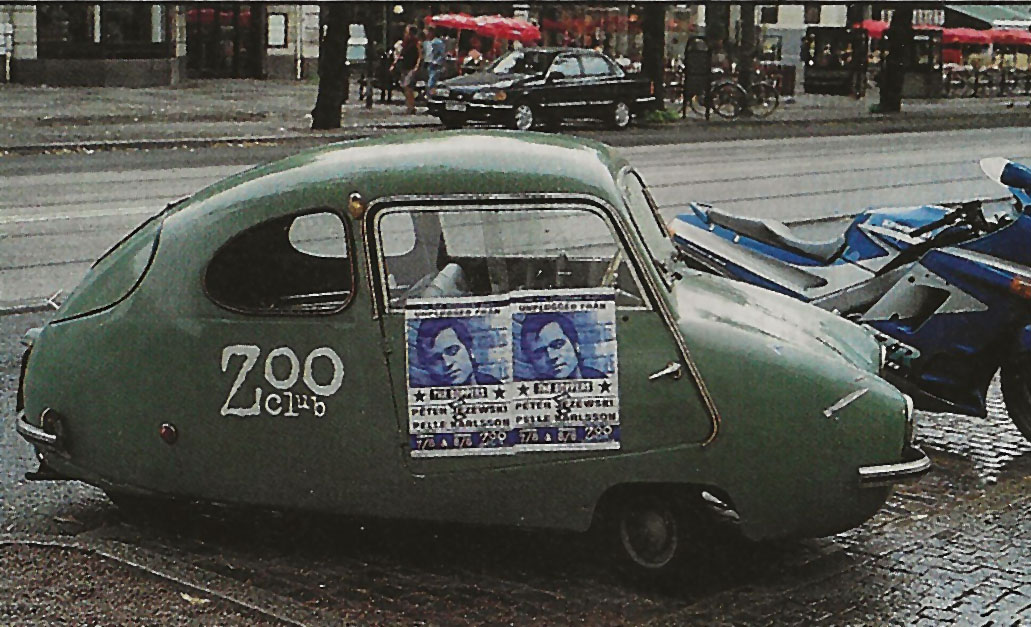


“Sitting curbside with rock in roll club advertisements taped to his doors, the brave little car shivered in the Swedish rain as tourist pointed, laughing at him.”
What a natural for Little Golden Books or a pre-Michael Eisner Disney cartoon this car seemed to be when we first saw it. All it needs is the rescue and the happily-ever-after. It certainly wouldn’t be right for this pioneer of economical motoring – and certainly someone’s pride and joy in some long ago – simply to perish ignominiously in a dark Swedish night.
History 1954-55 Fulda-Mobil originally published in AutoWeek November 21, 1994; republished by author John Matras.
That this Fulda-Mobil came to be an eye-catching kiosk for Goteborg’s nightspot The Zoo Club is surely some sad twist of fate. It must be rare. There were relatively few made to begin with, and as is common with cheap cars, most were probably discarded long ago.
Fulda-Mobil was the product of Elektromachinen Fulda Gmbh, of Fulda, in West Germany. A journalist named Norbert Stevenson built a prototype three-wheeler with two side-by-side seats and a Zundapp motorcycle engine mounted at the rear. Stevenson convinced industrialist Karl Schmitt, also the Bosch agent in Fulda, to put his brainchild in production. It was simple: Sheet aluminum was fitted to a wooden frame. There were no compound curves. It had flat sides and the overall profile of a teardrop with a windshield. The single rear wheel was driven by a 250 cc single-cylinder Ilo engine.
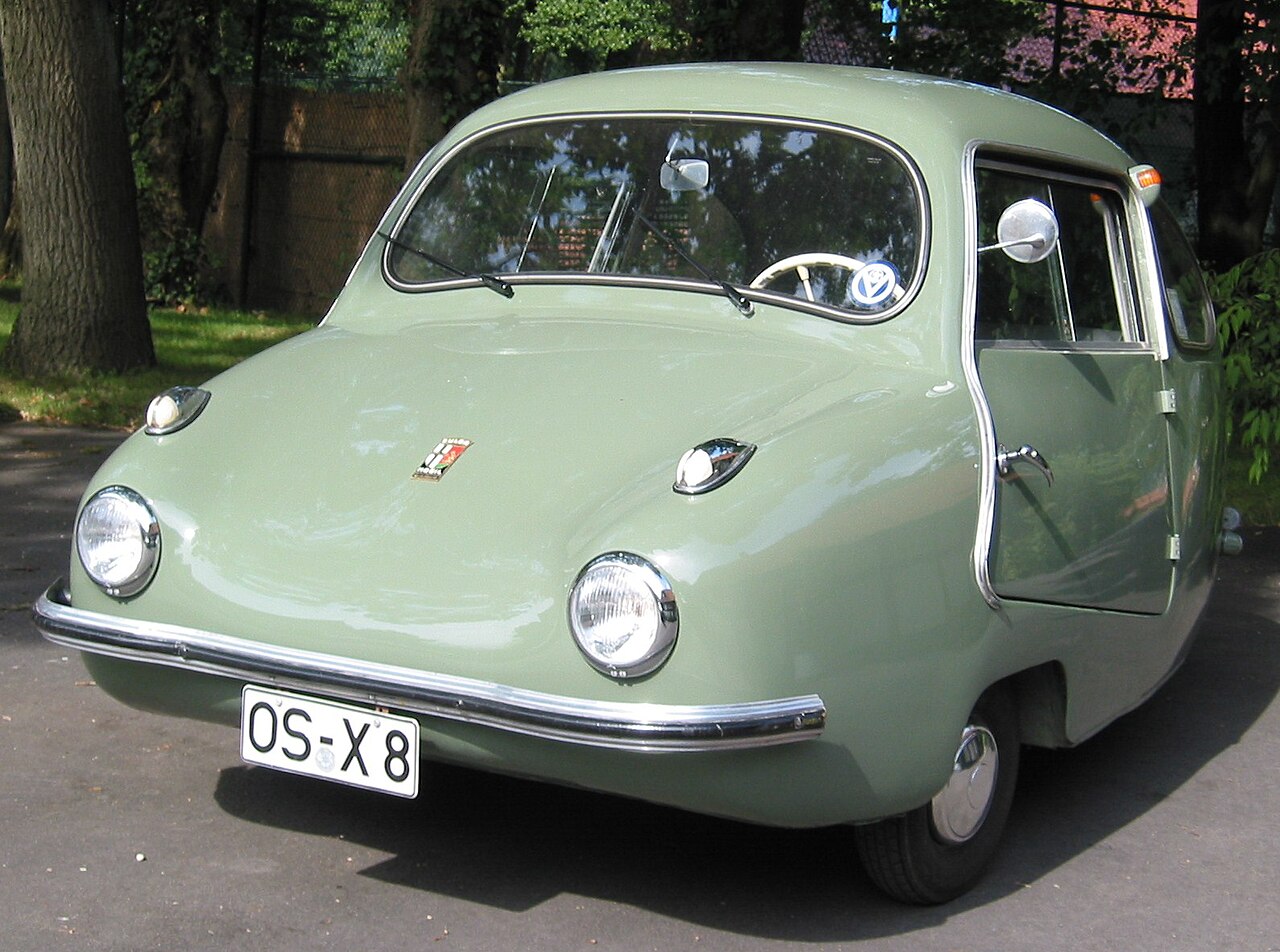
A much more sophisticated Fulda-Mobil production model followed, again with the three-wheel layout, but there was a hood with Renault Dauphinesque contours fitted to an ovoid cabin. Again, it was all in aluminum because steel shortages and an overall lack of cash were driving elements of the “bubblecar” fad that was developing. Petroleum, on the other hand, was no longer rationed but still expensive. The bubblecar got the motorcyclist out of the rain, even if the bubblecar was to a real automobile what a motor scooter was to a motorcycle.
The Fulda-Mobil found a receptive public. The first model, designated S-1, sold more than 700 examples in 1954 and ‘55, with the companion S-2 selling a total of 430. The S-4 went into production in 1955 with a choice of narrow-spaced rear wheels or, for tax purposes, the tricycle format. Between 1955 and ‘58, 170 were made. And S-6 model, from 1956 –‘57, totaled 125, while a four-wheeled S-7, built until the plant closed in 1965, sold 440 examples.
Price had something to do with the Fulda-Mobil’s reception. The Volkswagen Beetle was comparatively extravagant, selling for about DM4,000 in the early ‘50s. The Fulda-Mobil S-1 could be parked in front of your apartment building for a mere DM2,780.
The Fulda-Mobil even found a home abroad. Licensed version were manufactured in Greece by Alta, in Chile as the Bambi, in India as the Hans Vahaar, and in Great Britain as the Nobel. The Fulda-Mobil was produced under license even in Germany, by Nordwestdeutsche Fahrzeugbau Gmbh in 1954 and ‘55, and – by the badge on its dented nose – the Goteborg car was one of these Wilhelmshaven-built cars.
BMW, however, had much more success with Count Renzo Rivolta’s Isetta, of which some 160,000 were sold between 1954 in 1962. The Isetta was a better product made by an established if war-crippled automaker, being built alongside real cars including the advanced but unprofitable 507.
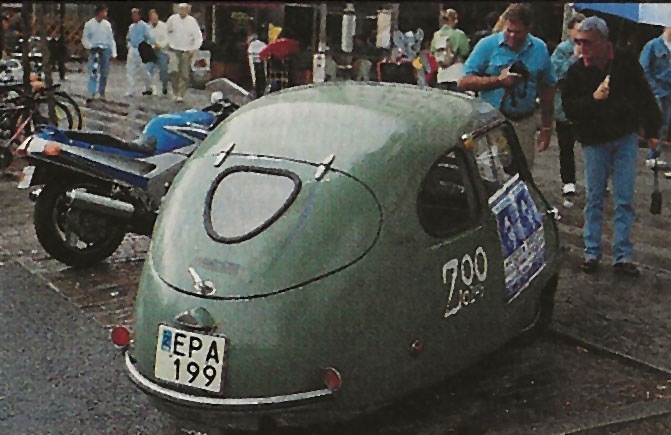
Still, looking at that forlorn Fulda-Mobil in the rain, one should not see only somewhat peculiar proportions. The flat windshield should be forgiven as a production exigency and not the designer’s desire. The almost heart -shaped backlight was a definite effort to work with the medium. As for the tiny wheels, well, it didn’t go that fast and surely smaller with tires were less expensive than larger ones.
This was a clever solution to a need for basic transportation that was fortunately short-lived. That Fulda-Mobil survived its rivals have more to do with its rivals’ alternatives. Messerschmitt sold its Kabinenroller business to return to more lucrative aircraft work and BMW moved upscale as fast is the market would allow.
As for the brave little car and Goteborg, its happily-ever-after has not yet been written. It resides in a motorcycle parking space, a sticker in the rear window advising Goteborg’s finest that: “Detta ar en mc-bil och far den sta po mc-parkering. Tak.” Or, according to our limited Swedist: “This is a motorcycle-car and therefore for that stands on motorcycle parking. Thanks.”
Perhaps some collector will add it to a warm and dry collection, remove the posters, push out the dents in its aluminum body and give the little car a fresh coat of pea-green paint. Besides, everybody loves a happy ending.
Addendum: The poor little Fulda-Mobil of Goteborg may have found a happy ending after all. According to classic.com, an “Original & Highly Original” Fulda-Mobil Nwf 200 sold for $54,333 in a Bring a Trailer auction.Cinderella, your pumpkin has arrived.
War torn Europe had a number of bubble cars but also cars slightly upscale, though it’s hard to think of cars like the Renault 2CV as “upscale,” compared to the Fulda-mobile, well, yes.
The original transparencies are somewhere in a safe place among all the other 30 years of car pictures so I did what I could to copy my photos that were used with the article.